When you purchase through links on our site, we may earn a commission. Here’s how it works.
Are you staring at a tangled mess that is growing all over your aquarium plants? You might have staghorn algae.
This branching growth, if left unchecked, can take over your entire tank. The good news is that you can turn things around just as quickly.
Table of Contents

What Staghorn Algae Looks Like
Staghorn algae is easy to spot once you know its telltale shape. It grows in stiff, branching clusters that look like tiny gray antlers.
The strands don’t sway in the current like hair algae. They keep their form, even when water is moving around them.
Most outbreaks start on the tips or edges of slow-growing plants. From there, it spreads to filter outlets, hardscape, and anything that catches detritus.
Watch: If you’ve ever wondered what staghorn looks like before it spreads, here’s a close-up of its first tiny antler-shaped tufts.
The color ranges from pale gray to smoky green, but as it matures, it takes on a darker, almost metallic tone. If you’re unsure whether you’re looking at Staghorn or another algae, check how it reacts to a light pinch.
Staghorn feels tough and wiry. It doesn’t smear between your fingers. It stays firm and breaks into rigid pieces rather than collapsing into mush.
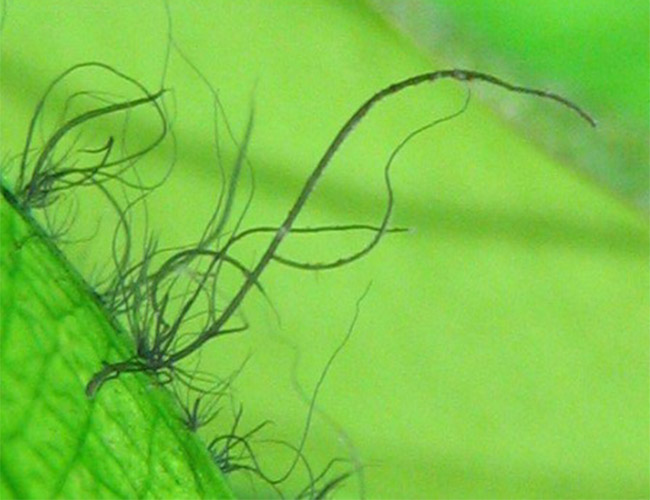
Quick ID: Staghorn Algae
- Rigid, branching “antler” shape
- Gray to green-gray tufts
- Clings to plant tips and filter outputs
- Tough, wiry texture that snaps cleanly
- Keeps its shape in moving water
Staghorn Algae vs Black Beard Algae
Staghorn algae and Black Beard algae are the two red algae species most often confused with each other. Fully grown black beard algae, on the left, is dense and bushy while Staghorn algae, on the right, is sparse and wiry.
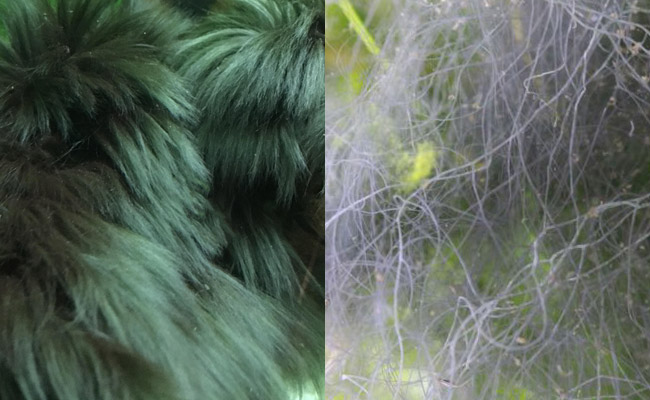
They grow in similar places and can look nearly identical in their early stages.
A quick comparison helps you confirm which one you’re dealing with before starting treatment.
How To Tell Staghorn & Black Beard Algae Apart In The Early Stages
Both algae start as tiny gray tufts, but their early growth patterns are different. Staghorn begins as thin, uneven strands that branch outward, while Black Beard forms tightly packed clusters from the very start.
Paying attention to texture and spacing helps you identify them before they mature.
Early-Stage Signs Of Staghorn Algae
- Appears as loose, uneven wisps with small fork-like splits
- Has gap spacing between each strand
- Feels wiry or rigid, even when very short
- Stays upright and does not sway in flow
- Often begins on leaf tips or spots with low flow
Early-Stage Signs Of Black Beard Algae
- Appears as dense, brush-like dots (like a tiny makeup brush)
- Grows in tight clusters with no branching
- Feels soft or velvety when rubbed
- May darken quickly even when young
- Often starts on wood, rocks, or equipment
The Fastest Early Tell
In the blue circle, you have black beard algae, resembling the tightly packed clusters of bristles you find on a makeup brush. Staghorn algae, circled in red, looks more like the antlers of a male deer.
- If it branches, even slightly, it’s staghorn.
- If it forms a solid, bushy “dot,” it’s Black Beard.
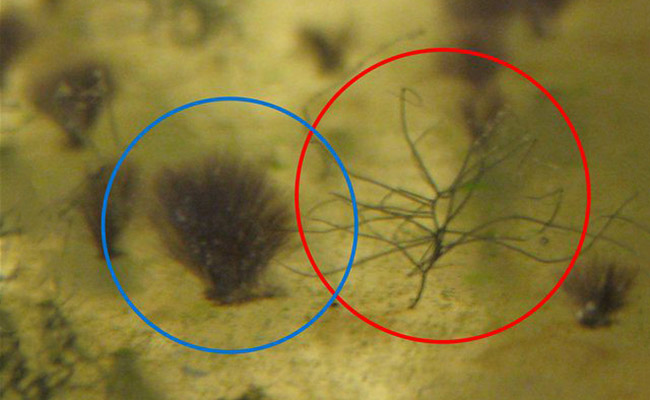
Even at just a few millimeters long, this branching vs. clustering difference is the most reliable early-stage ID.
Comparison Chart
Think you have black beard algae in your tank? Check out our black beard algae guide, with pictures and instructions on how to get rid of it!
| Feature | Staghorn Algae | Black Beard Algae |
|---|---|---|
| Shape | Thin, branching strands that look like deer antlers | Dense, brush-like tufts that resemble makeup bristles |
| Color | Gray or bluish | Dark gray to black |
| Texture | Wiry and snaps when pinched | Soft and velvety |
| Movement in Flow | Holds its shape and stays rigid | Gently sways or ripples |
| Common Locations | Plant tips, filter outlets, dead zones | Hardscape, wood, equipment, slow-flow areas |
Staghorn vs Algaes
Staghorn algae isn’t the only growth that forms on leaves and hardscape, and several other algae types can look similar when they first appear. A quick comparison helps you rule out the usual suspects and confirm that you’re dealing with true staghorn.
See our full algae guide with photos of all major aquarium algae and how to get rid of each one.
Where Staghorn Algae Grows First (And What It Means)
Staghorn doesn’t appear randomly. It shows up in the spots where your tank is the most unstable, which makes these areas early warning signs you should never ignore.
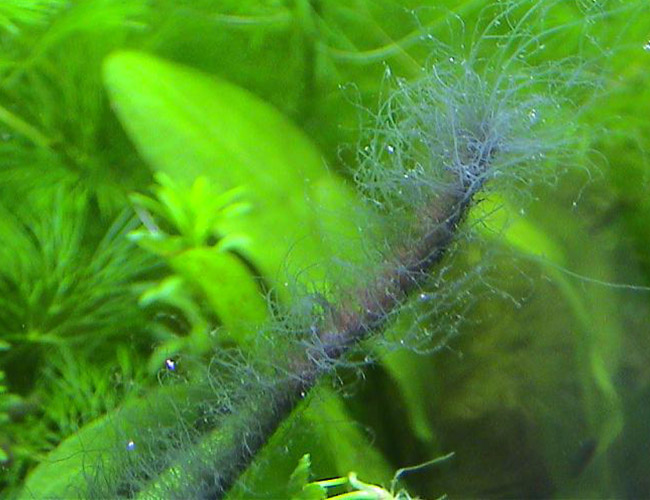
Common Hotspots
- Leaf tips and edges: Staghorn often anchors to older or damaged leaves where plant growth has slowed. If you see new tufts here, check CO₂ stability.
- Slow-flow corners: Dead zones allow CO₂ and nutrients to drift out of balance. Staghorn thrives in these pockets long before you notice issues elsewhere.
- Under or near the filter outflow: A surprisingly frequent location. Uneven CO₂ distribution or fluctuating flow can trigger staghorn right where water first re-enters the tank.
- Equipment edges and tubing: Areas around diffusers, intake grates, and tubing can trap debris or have irregular CO₂ exposure, creating perfect staghorn landing spots.
- Hardscape facing direct light
Even minor imbalances show up fastest on rocks and wood exposed to bright or prolonged lighting.
If you notice staghorn repeatedly growing in the same place, that’s your clue: something is off specifically in that zone.
Watch: A clear look at mature staghorn algae — note the gray, wiry, antler-shaped branches.
Is Staghorn Algae Harmful To Fish?
Staghorn algae is not harmful to fish or shrimp. Most livestock ignore it completely and will swim through it without stress. Some even pick at dying patches out of curiosity.
The main concern is not the fish, but the conditions that allowed the algae to grow. A tank with unstable flow or nutrients may affect sensitive species over time. Fixing the imbalance helps both fish and plants thrive.
Is Staghorn Algae Harmful To Plants?
Plants are much more affected bysStaghorn algae than fish are. As the algae spreads, it covers leaf surfaces and reduces the light plants need for photosynthesis. This effectively slows growth and weakens the plant over time.
Thick staghorn can also shade out slower-growing plants and carpet them entirely. These species often struggle to recover once leaves are smothered.
Trimming damaged foliage helps healthy growth return faster after treatment.
4 Reasons Staghorn Algae Appears
Staghorn algae doesn’t grow randomly. It shows up when something in your tank becomes unbalanced. Even small shifts can create the perfect conditions for an outbreak.
1. Unstable CO₂ or Carbon Levels
Low or fluctuating CO₂ is the number one cause of staghorn algae. Even small swings make plants slow down, giving staghorn an opening.
Tanks that use injected CO₂ or liquid carbon can develop blooms quickly if levels aren’t consistent.
Common CO₂ Issues
- A nearly empty CO₂ canister
- Clogged diffusers or blocked lines
- Incorrect injection rate
- Inconsistent liquid carbon dosing
2. Poor Water Circulation
Even when CO₂ is stable, weak circulation can allow staghorn to appear. Dead zones trap debris and limit nutrient and carbon distribution across the tank. Staghorn often starts in these low-flow pockets before spreading outward.
Common Flow-Related Triggers
- Filter output slowing down
- Clogged intake sponges or dirty media
- Hardscape blocking water movement
- Dense plant growth trapping waste
3. Nutrient Spikes
Sudden increases in ammonia, phosphate, or decaying plant matter can trigger a staghorn bloom. These spikes often follow overfeeding, plant melt, or irregular water changes. Staghorn reacts quickly to excess nutrients, even when tests look “mostly normal.”
Watch For
- Elevated ammonia in new or neglected tanks
- Extra waste from increased stocking
- Fertilizer dosing without matching plant growth
- Detritus buildup around stems or roots
Watch: This tank developed staghorn algae after heavy fertilizing — a real case of nutrient imbalance triggering a bloom.
4. Too Much Light
High or prolonged lighting pushes plants into a demand they can’t meet if CO₂ or nutrients are out of balance. This gives staghorn the advantage. Tanks with bright LEDs or long photoperiods are especially prone to fast algae growth.
Signs Your Lighting May Be Contributing
- Plants show slow recovery despite fertilizing
- Algae grows in the brightest areas first
- Photoperiod runs longer than 8 hours
How To Get Rid Of Staghorn Algae (The 2-Day Method)
Staghorn algae looks intimidating, but it responds quickly to targeted treatment. The fastest way to clear it is by fixing the conditions that caused it while hitting the algae directly.
Use this two-day plan to remove an entire outbreak.
Day 1: Improve Flow & Remove Waste
Start by restoring strong, even circulation throughout the tank. Good flow prevents detritus from settling and instantly weakens Staghorn’s grip. This step alone slows its spread within hours.
Do The Following
- Clean your filter intake and pre-filter sponges
- Rinse filter media in old tank water
- Adjust your output to eliminate dead spots
- Remove trapped debris from plants and hardscape
If your plants have heavily covered leaves, trim them. Removing damaged growth makes your treatment more effective. It also gives healthy plant tissue a clean slate to regrow.
Day 1: Spot-Treat The Staghorn
Once flow is restored, hit the algae directly. Liquid carbon (Seachem’s Flourish Excel or similar) and hydrogen peroxide are both effective, as long as they’re used carefully.
Apply them with the filter off so the treatment stays on the algae.
How To Spot-Treat Staghorn With Liquid Carbon
Liquid carbon products are among the most effective tools for controlling staghorn algae. These products don’t add CO₂ directly. Instead, they contain glutaraldehyde-based compounds that act as biocides, disrupting algal cell walls and interfering with algal metabolism.
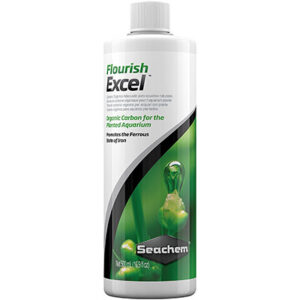
In Seachem Flourish Excel, the active form is polycycloglutaracetal, a stabilized and less reactive derivative of glutaraldehyde. This compound is safe for most plants when used correctly and also serves as an accessible carbon source. Applied directly, it weakens staghorn algae, causing the strands to turn pink or red as they die.
How To Apply It
- Turn off your filter before treating.
- Use a pipette or syringe to apply a small drop directly onto the algae, staying close to the manufacturer’s recommended daily dose for your tank volume.
- A typical approach is to apply the tank’s daily dose directly to affected spots, rather than adding it to the water column.
Liquid carbon is potent, so begin with conservative amounts. Treat only the patches you can reach, and avoid coating sensitive plants such as Vallisneria, mosses, and some ferns.
Watch: See how to treak your tank with Flourish Excel. Remember, always spot-dose with filter off.
After Treatment
- Staghorn usually begins changing color within 24 hours
- The strands turn red, pink, or translucent, indicating they are dying
- Most weakened algae will crumble or detach during the next water change
Safety Note: Liquid carbon products contain glutaraldehyde derivatives that may irritate skin, eyes, and lungs. Avoid direct contact by wearing gloves and washing your hands after use. Prevent splashes and keep the container away from your face while measuring.
How To Spot-Treat Staghorn With Hydrogen Peroxide (Safely)
Hydrogen peroxide (3% strength) can kill staghorn algae when applied directly. It works by oxidizing the algae, turning it pink or red within 24 hours. This method is best used as a small, controlled spot treatment.

How To Apply It
- Turn off your filter so the peroxide stays on the algae
- Use a pipette or syringe to apply a minimal amount onto the staghorn patch
- A common hobby starting point is around 0.5–1 mL of 3% peroxide per 10 gallons when used as a spot application
- Avoid delicate plants like Vallisneria, mosses, and liverworts
Watch: Watch staghorn algae being treated with hydrogen peroxide. Those bubbles? That’s peroxide oxidizing the algae on contact.
After Treatment
- Staghorn should begin fading to pink or red within a day
- Resume normal flow after 10–15 minutes
- Repeat only as needed, allowing 24 hours between treatments
Important: Hydrogen peroxide dosing is not standardized, and tank sensitivity varies. Always start small, test one area first, and monitor livestock closely.
Day 2: Water Change & Follow-Up Treatment
Perform a large water change the next day. This removes the weakened algae fragments and clears out the nutrients that fed the outbreak. Most clusters will fall apart on their own as they die.
If stubborn patches remain, apply a second light spot treatment. You won’t need nearly as much this time. The regrowth rate drops sharply once the initial bloom is controlled.
What Success Looks Like
- Staghorn turns red, pale pink, or white within 12 to 24 hours
- Tufts start breaking off when disturbed
- New growth slows or stops entirely
- Plants show stronger, cleaner growth after trimming
What To Do Once Staghorn Shows Discoloration
When staghorn algae discolors, the treatment has worked. You can stop dosing liquid carbon or hydrogen peroxide at this point — continuing won’t speed things up and may stress fish or plants.
The dead staghorn will begin breaking apart over the next few days. Shrimp and other algae-eaters often clean up the remains on their own. If you prefer a quicker cleanup, you can gently remove the loose strands by hand or trim any leaves that were heavily covered.
Watch: Don’t panic — the red color means the staghorn is dying, not spreading.
4 Ways To Prevent Staghorn Algae From Coming Back
Staghorn algae rarely returns in a stable, well-balanced tank. Most regrowth happens when CO₂ levels fluctuate, lighting runs too long, or flow slows down again.
These steps keep your tank consistent and make it harder for staghorn to reappear.
1. Stabilize CO₂ Or Liquid Carbon
CO₂ swings are the most common cause of staghorn returning after treatment. Plants slow down when carbon levels fluctuate, but algae takes advantage of it immediately. Steady CO₂ levels help plants outcompete algae in the long term.
Check For
- A consistent pH drop each day
- CO₂ starting 1–2 hours before lights turn on
- No leaks, clogs, or empty cylinders
- Even surface agitation that doesn’t strip CO₂ too quickly
If you don’t use pressurized CO₂, daily liquid carbon keeps carbon levels steadier. This gives plants the advantage they need to stay ahead of algae.
2. Match Lighting To Plant Needs
Too much light pushes plants harder than your nutrients or CO₂ can support. When plants fall behind, staghorn fills the gap. Shorter or less intense lighting often prevents the next outbreak.
Adjust As Needed
- Keep your photoperiod under 8 hours
- Dim LEDs if plants are pale or stalled
- Clean light fixtures to prevent hotspots
Timers are especially useful for beginners. Consistent lighting is one of the easiest ways to stabilize a planted tank.
3. Keep Water Flow Consistent
Good circulation stops debris from collecting where staghorn likes to grow. Flow also distributes CO₂ and nutrients so plants can use them effectively.
Weak circulation almost always leads to the same low-flow pockets that staghorn targeted before.
Improve Flow By
- Rinsing clogged intake sponges
- Adjusting your outflow to eliminate dead spots
- Trimming dense plant groups
- Vacuuming debris around stems and hardscape
4. Balance Nutrients For Your Plant Load
Plants thrive when nutrients match their growth rate. Too much or too little can create opportunities for algae. A steady fertilizing routine keeps your tank predictable.
Key Habits
- Dose fertilizers consistently
- Avoid overfeeding fish
- Remove melting leaves before they decay
- Test for ammonia after major changes
Weekly Staghorn Prevention Checklist
- Rinse filter intake sponges
- Remove debris from plant bases and hardscape
- Trim dying leaves
- Check CO₂ or liquid carbon consistency
- Keep lighting under 8 hours
- Perform regular water changes
5 Common Mistakes People Make With Staghorn Algae
Staghorn algae is easy to beat, but certain habits make it much harder to remove.
These mistakes can accidentally strengthen the algae or create the conditions that brought it on in the first place. Avoiding them keeps your tank stable and prevents repeat outbreaks.
1. Relying On Algae Eaters To Fix The Problem
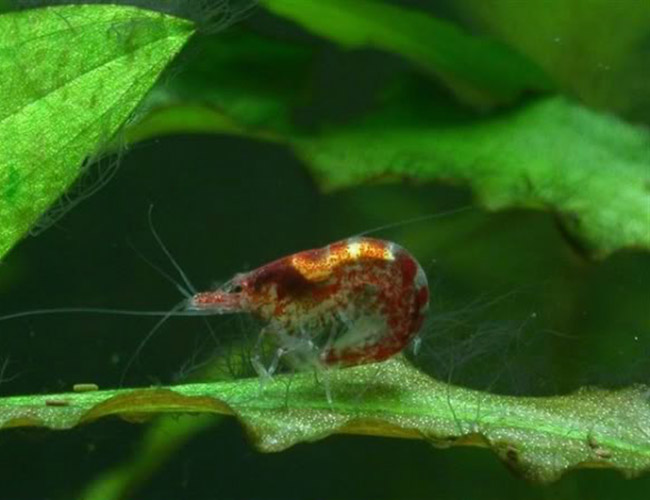
No algae eater reliably consumes live staghorn. Most shrimp and fish avoid its tough, wiry texture. Adding more livestock only increases waste and can worsen the bloom.
Why This Backfires
- Staghorn grows faster than fish can graze
- Extra fish increase nutrients and ammonia
- Algae eaters focus on softer algae types
2. Spot-Treating Without Fixing Flow
Spot treatments work, but they’re only half the solution. If your tank still has dead spots, the algae will regrow in the same areas.
Improving circulation makes every other method more effective.
Signs Flow Is The Real Issue
- Debris settling in corners
- Algae returning in the same locations
- Plants swaying unevenly in the current
3. Overdosing Liquid Carbon Or Peroxide
Too much liquid carbon or peroxide can damage plants and livestock.
Staghorn is tough, but you don’t need extreme doses to kill it. Controlled, targeted treatments work better and carry less risk.
Avoid These Mistakes
- Treating the whole tank instead of specific patches
- Repeating treatments too close together
- Spraying sensitive plants directly
4. Chasing Nutrients Instead Of Balancing Them
Some aquarists try to solve algae by removing all nutrients. This slows plant growth and creates a larger opening for staghorn.
Mild, predictable fertilizing is safer and more effective.
Common Misconceptions
- “No nitrates” does not prevent algae
- Cutting fertilizers drastically can harm plants
- Staghorn often appears in tanks with unstable nutrients, not high ones
5. Running Too Much Light For Too Long
High-intensity LEDs encourage algae when plants can’t keep up. Long photoperiods quickly push tanks out of balance. Reducing light is one of the simplest ways to prevent regrowth.
Watch For
- Bright hotspots where algae grows first
- Lights running more than 8 hours
- Pale or slow-growing plants despite fertilizing
Quick Fixes That Don’t Work
- Adding more algae eaters
- Turning lights off for multiple days
- Removing all fertilizers
- Treating repeatedly without improving flow
Frequently Asked Questions
Staghorn algae confuses many aquarists because it spreads quickly and behaves differently from other algae. These are the questions people ask most often when trying to identify it, treat it, or prevent it from coming back. Use this FAQ as a quick reference while you work through your outbreak.
Don’t see your question? Respond in the comments, and we’ll get back to you!
Does Anything Eat Staghorn Algae?
No common aquarium fish or shrimp reliably eat staghorn algae. Its tough, wiry texture makes it unappealing to grazers.
Even Amano shrimp usually ignore it unless it is already dying.
Why Did Staghorn Algae Appear So Suddenly?
Most outbreaks follow a slight imbalance in flow, nutrients, or CO₂. Even a minor ammonia spike or clogged filter intake can trigger new growth.
Staghorn spreads very quickly once conditions favor it.
Will Staghorn Algae Kill My Plants?
Staghorn doesn’t kill plants directly, but it can smother leaves and slow growth. Plants weakened by algae recover more slowly.
Removing affected leaves helps restore healthy growth.
Does Too Much Light Cause Staghorn Algae?
Excess light can contribute to a bloom when combined with unstable nutrients or elevated CO₂ levels. Bright LEDs push plants harder than they can keep up with. This creates an imbalance that staghorn can exploit.
Can Water Changes Help Remove Staghorn Algae?
Yes, water changes remove excess nutrients and weakened algae fragments. They’re most effective after spot treatment or flow improvements.
A large water change during treatment speeds up recovery.
How Long Does It Take Staghorn Algae To Die After Treatment?
It typically turns pink or red within 12 to 24 hours. This color shift means the algae is dying. Full breakdown usually takes one to three days.
Can Staghorn Algae Spread Between Tanks?
Yes, it can spread through equipment, plants, or shared aquascaping tools. Rinsing items and quarantining plants helps prevent cross-contamination. Once introduced, it grows quickly in unbalanced systems.
What’s The Fastest Way To Get Rid Of Staghorn Algae?
A combination of improved flow, targeted spot treatment, and stable nutrients clears it the fastest. Most outbreaks collapse within two days using this method. It also reduces the chance of regrowth.
Does Liquid Carbon Kill Staghorn Algae?
Yes, liquid carbon is highly effective when applied directly. It must be used carefully around sensitive plants and livestock.
Spot treatment is more effective than whole-tank dosing.
Can I Use Hydrogen Peroxide Instead Of Liquid Carbon?
Hydrogen peroxide works well for spot treatments. It is a good option for tanks that don’t use liquid carbon.
Apply it carefully to protect delicate plant species.
Ready To Level Up Your Planted Tank?
If you want to prevent future algae blooms and keep your aquascape healthy, these guides will help you build a more stable tank. Each one dives deeper into the systems that keep plants thriving and algae under control.
- How To Create A Self-Sustaining Aquarium
- Easy Steps To A Low-Stress Aquarium
- Tips To Keep Your Aquarium Fish Alive And Thriving
Simple changes make a huge difference. The more stable your tank becomes, the harder it is for algae to come back.


After reading your article on Black Beard Algae, I had to discover what Staghorn Algae is.
I’ve had aquariums for 60 years and I have never seen Staghorn Algae in any of my tanks, but I have seen it in other peoples tanks.
It’s good to see that the solution for Staghorn Algae and Black Beard (Hair) Algae is the same.
I’ve been battling Hair Algae for some time now that was introduced from the purchase of a plant from one of the three LFS in this area.
I’ve already got other Flourish products (Iron, Comprehensive Supplement) so now I’ve got to get Excel and give it a try. Thanks.
Hi Gator,
Isn’t this hobby fantastic? I’ve been keeping fish for over 30 years and I am still learning new things all the time – and I’ve been doing this half as long as you. I would love to hear your experience with Excel.
I have been doing my tank with Excel and it works great. But how do I remove the dead allegra? Does it eventually disappear or should I manually take it out?
Hi Brandon,
It all depends on how much algae there was and what you have in your tank. Many shrimp, and some other algae eaters, will happily eat dead staghorn algae until there is none left. If it’s a little, it will slowly break up and go away on it’s own, with much of it being trapped in your filter. If it’s a lot, you might want to manually remove it, doing a small area at a time so you don’t gunk up the rest of your tank.
Hi, I’ve been keeping nano tanks for years now and this is the first time I’ve encountered stag horn algae. It seems that it has appeared over night. It’s only in a high flow area of one of my tanks and everything has been constant for 6 months so I’m not sure what’s changed it to make it grow. I’ll have to test my tap water to see if something changed there.
Thank you for this article it’s been very helpful and informative.
Hi Jess,
Isn’t surprise algae the worst? I hope testing your water sheds some light on the issue.
Hi i have a 60L aquarium so tge 1st time i dose spot dose ml for 40L. Then how about 2nd dose? Still use full dose? Or 1.5ml
Hi Boey,
If you need a follow up dose, I tend to do the same amount of h202.
Thanks .. it seems the algae still sticking around even spot treatment.
Lights at 4 hr, 10% weekly water change.
The 1st 2 time i use 5ml then 1.5 for 2 days. Total 4 days the algae still around.
Hi Boey,
Is any algae turning red and dying off? Are you sure it’s staghorn?
Hi Ian, sorry for the late reply. A lot of people says its staghorn https://m.facebook.com/groups/8673790658?view=permalink&id=10156747553320659
I treated wth spot treatment daily 5ml. For some It did turn red.
I also did a 2 day blackout and a few drops excel on 2liters bucket for my US fisside and some turn red and some green hair algae gone.
Now left a few stings for green hair algae and some staghorn around. Still doing 5ml daily dose.
Hi Again, Boey.
That sounds like you are making progress. The green hair algae might have to be manually removed, depending how long the strands are, and where it’s attached, you can probably remove it with a toothbrush
Thank you, I found this to be informative and very helpful.
Hi Jess,
Thank you for the kind words, I hope it solved your staghorn problem!
I’ve heard that small amounts of hydrogen peroxide will help. Is that true? Great article.
Ho Mona,
Yes, a good spot treatment of hydrogen peroxide will also work really well. However, I don’t recommend it to beginners. I have seen many newbies nuke their tank by either incorrectly applying it or following a youtube video that gave incorrect advice. It’s a lot harder to make a mistake with flourish excel. If you are confident, give it a go!
Hi Ian,
Have you tried treating different forms of algae with Easy-Life Algexit yet ?
Hi Spencer,
We don’t get many Easy-Life products over in the US, they are difficult to track down. Unfortunately because of this I don’t have a whole lot of experience with them other than what those over in the EU anecdotally say on forums.
Can I use the liquid co2 to combat the staghorn aswell as my co2 injection ?
Hi Steve,
Up front, I do not have personal experience adding liquid co2 while injecting it at the same time. I guess the big concern would be any fish you have. I would theorize that as you are keeping the total co2 in a habital zone, it should be fine.
I’ve kept my injected co2 at the same levels, whilst adding a small amount of easy carbo daily.started noticing the staghorn on the edges of leaves turning pink so im gradually upping the dose of the carbo for an even better result.dont want to dose to much too quickly and end up with a fish kill or any other related problems. Seems.to working so I’ll carry on.
thanks.
Hi Steven,
Thanks for the update. If the staghorn is turning pink it sounds like the treatment is working and it’s in the early stages of dying off.
Now its turned pink ,will it go away on it’s own or do I have to manually remove it ? Amano Shrimp and and nerite snails dont seem to be touching it.
Hi Steve,
Is the entire plant red/pink and dead? Or only parts. I have only seen algae eaters chomp on it when it’s completely dead. Also, if your nerites and shrimp are very well fed, they may be less inclined to eat it.
Hello, Ian Sterling. Thank you so much for posting this. Straight forward and easy to understand. Lol, helpful, too. I am raising some Caridina shrimp in a tank that has developed a few patches of staghorn algae that looks like pubic hair! I had no idea. Lol. My question is….Is it safe to use Excel Flourish with baby shrimp? They are 31 days old
Hi Tracy,
While it is invert safe (shrimp) I can only say anecdotally how it would affect baby shrimp. A member of of my local fish club has used flourish excel while the shrimp were breeding and with baby shrimp. The survival rate was as expected.
hello. i don’t know what’s going with my tank. some kind of algae but i couldn’t be sure. i really need help.
Hi Tim,
Unfortunately, there isn’t enough information here to provide insight into what you may be experiencing
Hi Ian,
I found this article on Staghorn algae,Thank You!
It’s plaguing my 30 gallon planted community tank. I’m dosing the full line of Seachem water additives, Flourish Advance, Flourish Excel, Iron, Potassium and Phosphorus in the recommended doses. My Light is on a timer, 8 hours a day. I just started running a pressurized CO2 tank, through an inline diffuser, into my Fluval 207 filter return line.
So there is the setup, I have about a dozen different types of plants in the tank, stems, mosses, Java Fern, Swords, Crypts. I’d say mostly the plants with the larger leaf areas are the ones with the Staghorn on them, and mostly the plants lower in the water column of the tank.
Now my question, should I up the CO2 injection a bit, while keeping it safe for the fish & shrimp in the tank, until I start to see the Staghorn turn pink, or with this just happen over time since the CO2 system is only about a week old.
Alternately, rather than spot dosing, could I pull the affected plants out an do a bucket dip with an Excel / Water mixture to treat the entire plant? Would there be any adverse effects, other that disturbing the setup of the tank and having to replant whatever I pull out to give a bath.
Hi Chad,
If you are doing a bucket dip, I recommend looking into h202. I can’t think of any downside to this except having to replant each plant, which depending on how much the staghorn algae has spread, may be a few of them.
Ok so would you do a mixture 50/50 water & peroxide, Or just 100% peroxide dip?
Hi Chad, I do a 3:1 water to peroxide dip for 6 minutes. Be mindful that this will work on algae and similar, but won’t kill some hitchikers such as snail eggs. I know many people use a 50/50 solution, but I have some sensitive plants and find the 3:1 works better for me.
Thank you very much very helpful article – great pictures, explanation and advice!
Hi
I’ve got staghorn algae, little bits popping up everywhere! Really pissing me off!. Manually cutting off affected leaves or removing it, daily. Lots of CO2 injection and dosing with Aquadesign Carbo at 2mls per 50lr but it’s not turning pink🫣😩. All liquid carbon products the same?
Reduced fertilizer dosing and lights by one-third.
Any other helpful pointer would be most grateful!
Hi, very informative.
I’ve tried every trick it the book to get rid of my STAGHORN algae!
Injecting Co2
Spot treating with hydrogen peroxide
Dosing flourish Excel
50%water changes & blowing out debris and sucking it out
Lights on 75%for 5.5 hours
E.I. method of fertilizer dosing but have reduced it by 1/4th.
Cutting off any infected leaves with it on.
It’s got a lot of plants in the tank
It’s not infested but it’s not going away!!!
Any other ideas?
I’m loosing hope
Hi Neil. Sounds like you’ve really been thorough in your efforts to combat staghorn algae! Have you considered reviewing your tank’s flow dynamics? Sometimes increasing water circulation can help prevent algae by distributing nutrients and CO2 more evenly. Also, double-check your tank’s nutrient balance. Lastly, give your tank some time to stabilize after these changes before you make further adjustments.
Hi, very informative.
I’ve tried every trick it the book to get rid of my STAGHORN algae!
Injecting Co2
Spot treating with hydrogen peroxide
Dosing flourish Excel
50%water changes & blowing out debris and sucking it out
Lights on 75%for 5.5 hours
E.I. method of fertilizer dosing but have reduced it by 1/4th.
Cutting off any infected leaves with it on.
It’s got a lot of plants in the tank
It’s not infested but it’s not going away!!!
Any other ideas?
I’m loosing hope