When you purchase through links on our site, we may earn a commission. Here’s how it works.
Jack Dempsey cichlids are bold, territorial, and not afraid to throw their weight around, so choosing tank mates isn’t about finding “friendly” fish. It’s about picking species that can handle the same water conditions, won’t get bullied, and won’t constantly trigger fights.
In this guide, we’ll break down 10 Jack Dempsey tank mates ranked by real-world compatibility and risk level, so you know which pairings are usually reliable, which ones are situational, and which belong in expert-only tanks.
Table of Contents
Jack Dempsey Tank Mates – What You Need To Know
Before you start looking for tank mates, you’ll need to know what kind of fish your Jack Dempsey is, and what kind of environment it prefers.
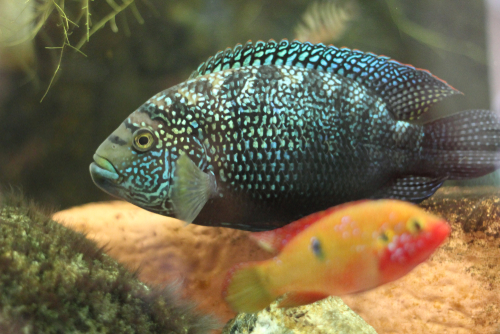
Temperament
Jack Dempseys aren’t shy, retiring fish, and they’ll pick a fight with a fish species that’s too aggressive.
As an ideal tank mate, you’ll want a fish that’s not too aggressive, but also a species that isn’t shy or a pushover. If your chosen tank mate is too timid, they may wind up being pushed out of the picture, or worse, on the menu.
Jack Dempsey Reality Check
Jack Dempsey cichlids are intelligent, territorial fish with strong personalities—and their behavior can change with age, breeding status, and tank conditions. A tank mate that works today may not work forever, especially if space becomes limited or water quality slips.
Size
Jack Dempseys aren’t the largest of fish, but they can get to be a fair size.
Males can reach a size of up to 10 inches in length, so you don’t want to choose a 1-2 inch fish unless you know it can keep itself out of trouble.
Competition
Jack Dempseys are carnivorous fish that prefer a diet of things like worms, insects, and other fish. When choosing a tank mate, you may want to look for fish that won’t compete directly for food.
Jack Dempseys can be a bit territorial, so fish who know how to share are a bonus.
Water Parameters & Tank Setup (Important)
Jack Dempsey cichlids are adaptable fish, but stable conditions are critical—especially in community tanks with other semi-aggressive species.
Recommended parameters:
- Freshwater aquarium
- Temperature: 72–82°F (22–28°C)
- pH: 6.5–8.0 (slightly neutral to mildly alkaline)
- Moderate hardness
- Strong filtration with steady flow
- Rockwork, caves, and visual barriers to break the line-of-sight
While Jack Dempseys can tolerate a range of conditions, sudden changes in temperature, pH, or water quality often trigger aggression. Larger tanks with structured aquascaping dramatically improve long-term compatibility with tank mates.
Tank Size Matters More Than Species
Most Jack Dempsey tank-mate problems stem from space, not compatibility charts. Larger tanks with caves, rockwork, and visual barriers dramatically reduce aggression by allowing fish to establish territory and avoid constant line-of-sight confrontations.
Top Jack Dempsey Tank Mates
No tank mate is guaranteed with Jack Dempsey cichlids—success depends on tank size, layout, individual temperament, and close observation.
Tank Mate Risk Levels
- Low Risk – Generally reliable in large, properly set up tanks
- Moderate Risk – Works with space, experience, and monitoring
- High Risk – Unpredictable; not recommended for most aquariums
- Expert Only – Requires very large tanks and advanced management
Note: Even “Low Risk” tank mates require sufficient tank size, proper aquascaping, and monitoring.
Jack Dempseys often become more aggressive as they mature, even if they were peaceful juveniles. Many tank mate issues don’t appear until months later, which is why long-term planning matters.
1. Hoplo Catfish (Low Risk)
If you want a bottom-dweller that’s tough, calm, and unlikely to stir up drama, the Hoplo catfish is one of the most dependable options for a Jack Dempsey setup.
- Scientific Name: Megalechis thoracata
- Adult Size: Up to 8 inches
- Compatible With: Jack Dempseys, Black Tetra, Kuhli Loach, Oscar Fish, Jaguar Cichlid (among others)
- Water Temperature: 72 to 86 degrees Fahrenheit
- Minimum Recommended Tank Size: 45 gallons
- Care Level: Easy
- Origin: South America
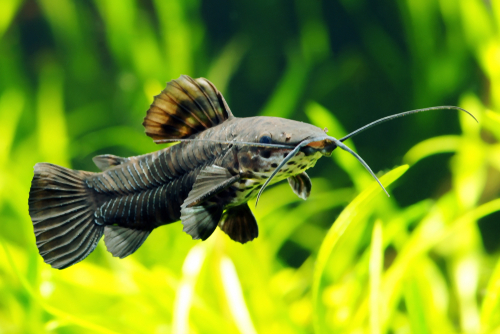
These peaceful and energetic catfish may not be brightly colored, but they’re considered excellent tank mates for Jack Dempseys because of their omnivorous diet and placid nature.
Why They’re Compatible
- Calm, non-confrontational temperament
- Spends most of its time on the bottom, away from Jack Dempsey’s territory
- Hardy and adaptable to a range of water conditions
- Protective body structure helps reduce injury
Important Considerations
- Needs hiding spots to feel secure
- May become defensive during spawning
- Should be fed sinking foods to prevent competition at the surface
2. Striped Raphael Catfish (Low Risk)
The striped Raphael catfish is a classic “leave me alone, and I’ll leave you alone” tank mate—armored, hardy, and usually invisible until the lights go out.
- Scientific Name: Platydoras armatulus
- Adult Size: Up to 8 inches
- Compatible With: Jack Dempseys, Oscar Fish, Black Skirt Tetra, Jaguar Cichlid, Bristlenose Pleco (among others)
- Water Temperature: 75 to 80 degrees Fahrenheit
- Minimum Recommended Tank Size: 50 gallons
- Care Level: Fairly easy
- Origin: South America
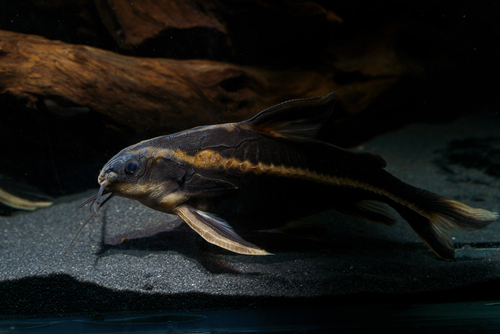
These mid-size fish are considered an excellent addition due to their calm nature and ‘aquarium cleaner’ reputation. They’ll eat anything organic they can get, which makes feeding them easy.
While they’re often bottom-feeding and nocturnal, they have been known to change both habits over time.
Why They’re Compatible
- Thick armor protects against aggressive tank mates
- Nocturnal habits reduce daytime conflict
- Generally ignores other fish
- Very hardy once established
Important Considerations
- Mostly active at night and often hides during the day
- Prefers to be kept in small groups for confidence
- Will eat leftover food, but still requires intentional feeding
3. Blue Acara (Low–Moderate Risk)
Blue acaras are often recommended because they match a Jack Dempsey’s vibe: sturdy, confident, and not looking for a fight, provided the tank has space and structure.
- Scientific Name: Andinoacara pulcher
- Adult Size: 6 to 7 inches
- Compatible With: Jack Dempseys, Cory Catfish, Oscar fish, Rainbowfish, Plecos (among others)
- Water Temperature: 72 to 82 degrees Fahrenheit
- Minimum Recommended Tank Size: 30 gallons
- Care Level: Fairly Easy
- Origin: South and Central America
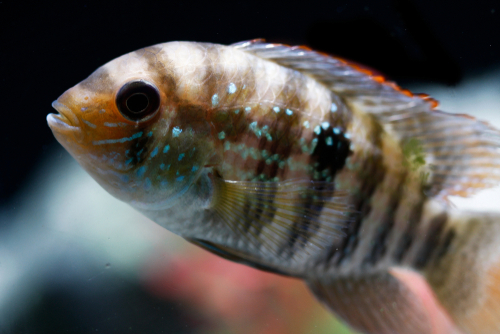
This fish is a popular choice for its gorgeous coloring, as well as its moderate temperament and fairly easy care requirements. As a tank mate for a Jack Dempsey, it can be ideal as it’s a similar size, has similar requirements, and is capable of defending itself.
Why They’re Compatible
- Similar size and temperament to Jack Dempseys
- Capable of defending itself without constant aggression
- Adaptable diet and hardy nature
- Generally less aggressive than many Central American cichlids
Important Considerations
- Can become territorial during breeding
- Requires stable water conditions to avoid aggression spikes
- May compete directly for food at feeding time
4. Common Pleco (Moderate Risk)
A common pleco can be a solid Jack Dempsey tank mate in large tanks, thanks to its armor, but its adult size and waste output make it a commitment, not a quick add-on.
- Scientific Name: Pterygoplichthys species
- Adult Size: 15–24 inches (species dependent)
- Compatible With: Jack Dempseys, Oscar Fish, Green Terror Cichlids (with sufficient space)
- Water Temperature: 74–80°F
- Minimum Recommended Tank Size: 100+ gallons
- Care Level: Moderate
- Origin: South America
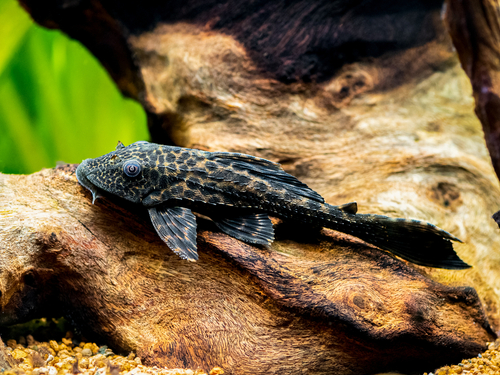
Their tough plating helps protect them from territorial disputes, especially once fully grown.
However, it’s important to note that common plecos are not strictly vegetarian. While they do consume algae, they are omnivores and require supplemental foods such as sinking wafers, vegetables, and occasional protein. As they mature, some individuals can become territorial, particularly toward other bottom-dwellers.
Because of their eventual size and waste output, common plecos should only be kept with Jack Dempseys in large, well-filtered aquariums.
Why They’re Compatible
- Armored body helps deter harassment from territorial cichlids
- Occupies the bottom of the tank, reducing direct conflict
- Tolerates a wide range of water conditions
Important Considerations
- Grows very large and produces heavy waste
- Requires supplemental feeding; not just an algae eater
- They can become territorial toward other bottom-dwellers as they mature
- Needs a large, well-filtered aquarium to thrive long term
5. Firemouth Cichlid (Moderate Risk)
Firemouths tend to be more defensive than aggressive, making them a workable match with Jack Dempseys as long as each fish gets its own territory.
- Scientific Name: Thorichthys meeki
- Adult Size: Up to 6 inches
- Compatible With: Jack Dempseys, Rummy Nose Tetra, Clown Pleco, Rainbowfish, Kuhi Loach, Platies (among others)
- Water Temperature: 75 to 86 degrees Fahrenheit
- Minimum Recommended Tank Size: 30 gallons (+5-10 per fish)
- Care Level: Fairly Easy (Just make sure you know their requirements)
- Origin: Mexico and Central America
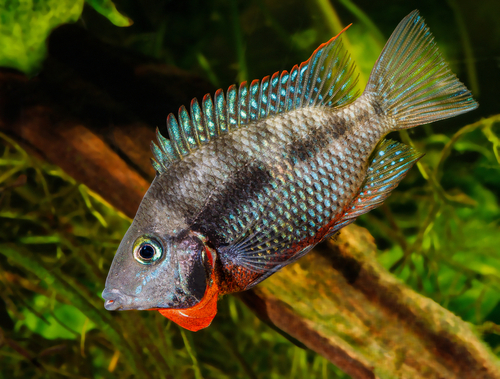
These fish are a favorite among aquarists for their bright colors, especially the red under the chin that gives them their name. They may be smaller than Jack Dempsey cichlids, but they have a semi-aggressive and defensive nature that means they can hold their own.
As long as they have enough room to respect each other’s territory, these two can make colorful and amiable tank mates.
Why They’re Compatible
- Semi-aggressive but typically defensive rather than combative
- Uses threat displays more often than actual fighting
- Similar environmental requirements to a Jack Dempsey
Important considerations
- Requires a clearly defined territory
- Can become aggressive if crowded
- May compete for similar food sources
6. Convict Cichlid (Moderate Risk)
Convict cichlids are small but fearless, which can work in their favor, until breeding season turns them into tiny, striped wrecking balls.
- Scientific Name: Amatitlania nigrofasciata
- Adult Size: 4 to 5 inches
- Compatible With: Jack Dempseys, Clown loach, Silver Dollar Fish, Oscar Fish, Pictus Catfish (among others)
- Water Temperature: 79 to 84 degrees Fahrenheit
- Minimum Recommended Tank Size: 30 gallons
- Care Level: Moderate
- Origin: Central America
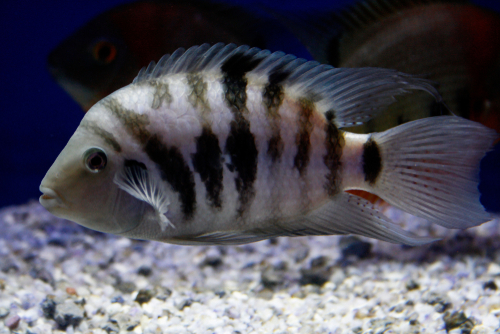
Named for the attractive stripes that adorn their sides, these fish may be smaller, but they’ve got plenty of attitude to hold their own with their larger Jack Dempsey cousins. Breeding pairs have been known to drive away a Jack Dempsey that gets too interested in their young.
These fish make good tank mates for that reason, and because they have a flexible diet, and they’ll respect each other’s territory as long as there’s enough space
Why They’re Compatible
- Extremely tough and capable of defending territory
- Shares similar water parameters with Jack Dempseys
- Can coexist peacefully when not breeding
Important considerations
- Breeding pairs become highly aggressive
- Small size can lead to overconfidence and constant skirmishes
- Requires ample space and visual barriers to reduce conflict
7. Silver Dollars (Moderate Risk)
Silver dollars can “buffer” a Jack Dempsey tank by schooling in open water, but they only work well when kept in a proper group with serious swimming space.
- Scientific Name: Metynnis species
- Adult Size: Up to 8 inches
- Compatible With: Jack Dempseys, Kuhli Loach, Common Pleco, Oscar Fish, Clown Plecos, Cory Catfish (among others)
- Water Temperature: 75 to 82 degrees Fahrenheit
- Minimum Recommended Tank Size: 75 gallons
- Care Level: Fairly Easy
- Origin: South America
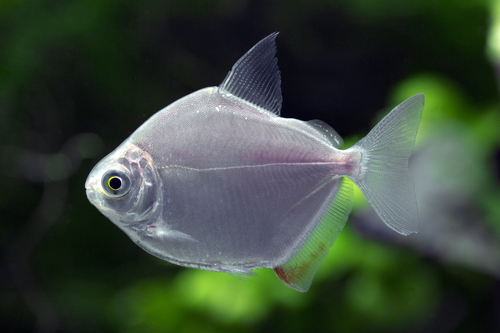
These bright, schooling fish live up to their name in appearance, as their most common appearance involves bright silver scales and a semi-rounded body.
Silver Dollars are high on the list of Jack Dempsey tank mates because of their peaceful temperament and vegetarian diets.
Why They’re Compatible
- Large, fast-moving schooling fish
- Generally peaceful and difficult to bully
- Occupy mid-to-upper water levels
Important considerations
- Must be kept in groups to reduce stress
- Require a large tank with swimming space
- Will eat aquarium plants
- Can become targets if kept in undersized tanks
8. Giant Danio (Moderate Risk)
Giant danios are fast, active, and hard to bully, which helps—but they need room to race and a group to feel secure, or the stress shows fast.
- Scientific Name: Devario aequipinnatus
- Adult Size: About 5 inches
- Compatible With: Jack Dempseys, Cory Catfish, Clown Loach, Tiger Barbs (among others)
- Water Temperature: 72 to 75 degrees Fahrenheit
- Minimum Recommended Tank Size: 30 gallons
- Care Level: Easy
- Origin: South Asia
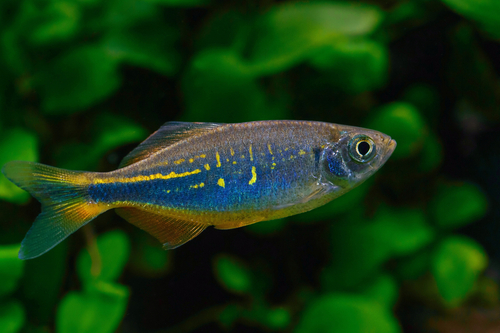
This peaceful schooling fish is a gorgeous golden color with blue highlights, making it a lovely addition to the tank. Its active nature makes it too fast to be caught by a temperamental Jack Dempsey, but its mild nature can encourage more timid fish to come out more often.
Why They’re Compatible
- Very fast swimmers that avoid direct confrontation
- Active schooling behavior can distract from aggression
- Hardy and adaptable
Important considerations
- Requires a group to feel secure
- Needs an open swimming space
- Can stress Jack Dempseys if the tank is too small
- May compete for food at the surface
9. Tinfoil Barb (Moderate Risk)
Tinfoil barbs are peaceful bruisers: big, quick, and sturdy enough to avoid being pushed around—if the tank is large enough to handle their size and energy.
- Scientific Name: Barbonymus schwanenfeldii
- Adult Size: 14 inches
- Compatible With: Jack Dempseys, Silver Dollars, Clown Loach, Jaguar Cichlid (among others)
- Water Temperature: 72 to 77 degrees Fahrenheit
- Minimum Recommended Tank Size: 175 gallons
- Care Level: Easy
- Origin: Southeast Asia
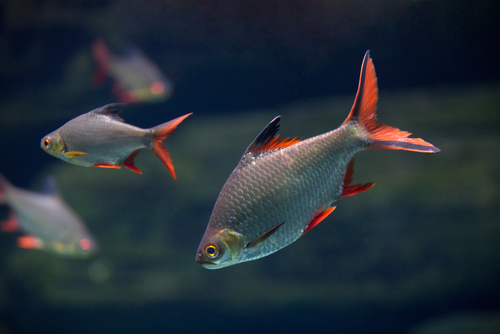
Silver bodies and red fins, a striking combination, characterize these beautiful fish. An active schooling fish, they’re too big and fast for a tetra to mess with, making them excellent tank mates.
Why They’re Compatible
- Large, fast-moving schooling fish
- Peaceful temperament despite size
- Less likely to be bullied when kept in groups
Important considerations
- Grows very large and needs substantial tank space
- Must be kept in schools
- Heavy bioload increases filtration demands
10. Jaguar Cichlid (EXPERT ONLY)
Jaguar cichlids are impressive but intense, and while they can coexist with Jack Dempseys in very large tanks, this pairing is for experienced keepers only.
- Scientific Name: Parachromis managuensis
- Adult Size: 16+ inches
- Water Temperature: 73–82°F
- Minimum Recommended Tank Size: 150+ gallons
- Care Level: Moderate to Advanced
- Origin: Central America
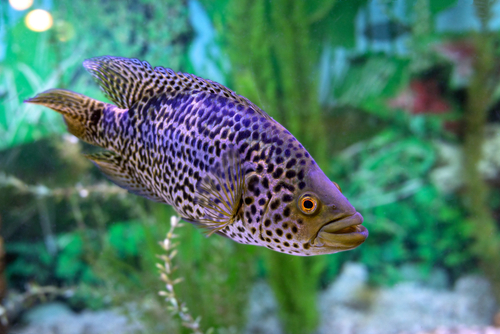
Keep in mind that Jaguar cichlids are large, powerful, and highly territorial fish. While their size can prevent them from being bullied by Jack Dempseys, the reverse is often true—Jaguar cichlids may dominate or seriously injure Jack Dempseys in confined spaces.
This pairing should only be attempted by experienced aquarists in very large aquariums with careful aquascaping, multiple territories, and close behavioral monitoring. For most home aquariums, Jaguar cichlids are not recommended as tank mates for a Jack Dempsey.
Why They’re Compatible
- Large size prevents being easily bullied
- Hardy and adaptable to varied conditions
Important considerations
- Extremely aggressive and territorial
- Requires very large tanks to prevent constant fighting
- Often dominates or injures Jack Dempseys
- Not recommended for most home aquariums
Other Jack Dempsey Tank Mates to Consider
These species are not universally compatible and should only be attempted in large, well-structured aquariums.
These fish can sometimes be kept successfully with Jack Dempsey cichlids, but this is more situational. Tank size, layout, and individual temperament matter greatly.
- Severum Cichlid – A calmer, thick-bodied cichlid that can coexist in large tanks, though territorial behavior may appear during breeding.
- Texas Cichlid – Similar size and confidence level, but aggression varies widely; best reserved for experienced keepers with ample space.
- Salvini Cichlid – Smaller but bold and fast; can work in larger tanks with heavy décor and clear territory separation.
- Bristlenose Pleco – A smaller pleco option that’s easier to manage than common plecos, though still requires hiding spots.
- Pictus Catfish – Active and quick, which helps avoid aggression, but requires schooling and strong filtration.
- Synodontis Catfish (larger species) – Tough, nocturnal catfish that occupy different tank zones, reducing direct conflict.
You might also like:
- African Clawed Frog Tank Mates
- Peacock Cichlid Tank Mates
- German Blue Ram Tank Mates
- 15 Best Crayfish Tank Mates
Setting Your Jack Dempsey Tank Up for Long-Term Success
Choosing Jack Dempsey tank mates is only half the equation. Long-term success depends on tank size, layout, and consistent care. Many compatibility issues stem from avoidable setup mistakes, overcrowding, or irregular maintenance, rather than from the fish themselves. If aggression suddenly increases, it’s often a sign that something in the environment needs adjusting, not that the tank mates were a bad choice.
Focus on the fundamentals: stable water quality, appropriate substrate and hiding spaces, and a feeding routine that minimizes competition. Staying on top of maintenance and nutrition goes a long way toward keeping stress low in semi-aggressive tanks. These guides can help you fine-tune the essentials: common aquarium mistakes, tank cleaning schedules, substrate choices, and feeding strategies.
Have you kept Jack Dempseys with tank mates? Share what worked, and what didn’t, in the comments. Tank size, layout, and species combinations help other aquarists make smarter, safer choices.


In what world is a bosemani rainbow a fit match with A Jack Demsey. Ai much?
That’s a fair call-out, and you’re right to question it. Boesemani rainbowfish aren’t a good fit with Jack Dempseys in most home aquariums. This comment came in before we updated the article, the site is under new ownership, and we’ve been actively reviewing and correcting older content. That pairing has since been removed, and the guide now focuses on real-world compatibility and clearer risk levels.
Out of curiosity, what fish are you keeping now, or have you had experience with Jack Dempseys yourself? Thanks again for helping us improve the info.