When you purchase through links on our site, we may earn a commission. Here’s how it works.
Blue-green algae is one of the most misunderstood problems in freshwater aquariums.
Despite its name, it isn’t algae at all; it’s a fast-growing group of bacteria called cyanobacteria, and once it takes hold, it can spread across a tank in a matter of days.
Table of Contents
Aquarium owners often mistake it for harmless algae and try common fixes like reducing light or adding algae eaters, neither of which reliably works. In the meantime, the cyanobacteria continue to expand, smothering plants, fouling the substrate, and making the tank increasingly unstable.
The good news is that blue-green algae can be identified accurately and eliminated effectively once you understand what you’re dealing with and why it appears in the first place.
In this guide, I’ll explain exactly what blue-green algae is, how to distinguish it from true algae, what conditions allow it to thrive, and the most reliable methods for removing it — without harming your fish, plants, or biological filter.
What Is Blue-Green Algae? (And Why It Isn’t Actually Algae)
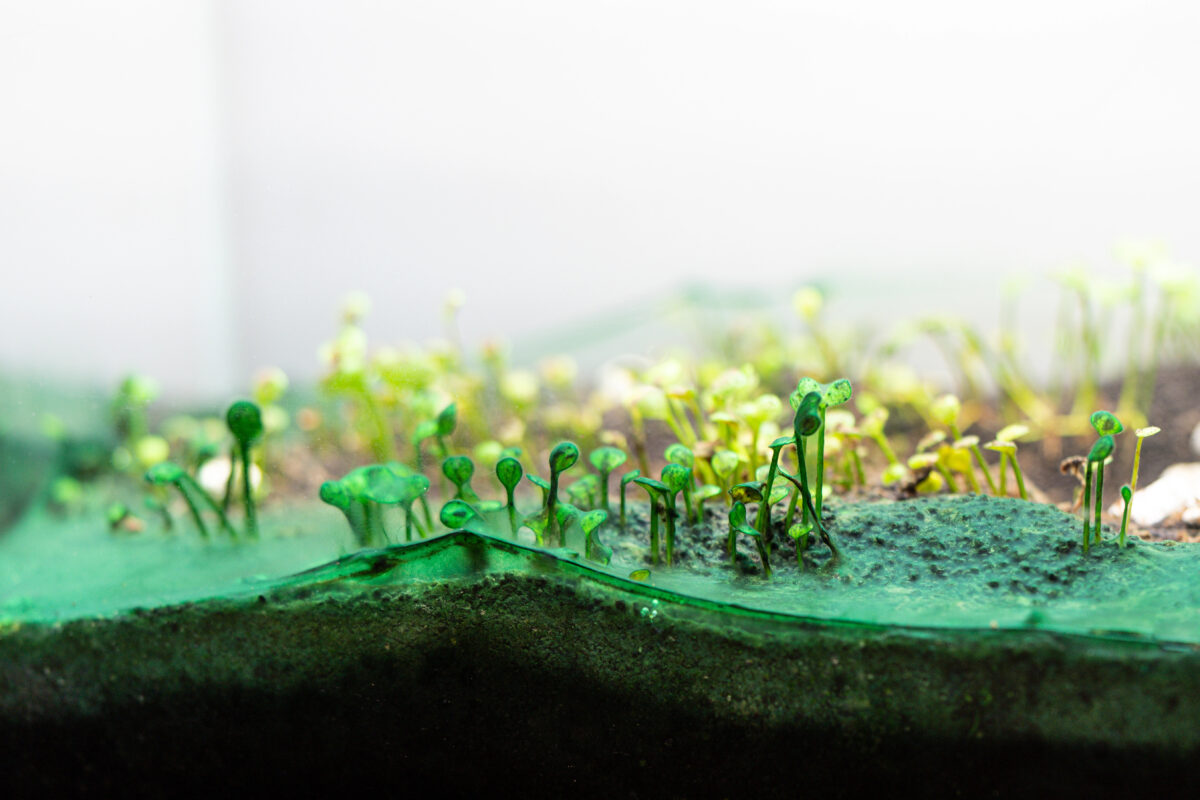
Despite its name and appearance, blue-green algae isn’t actually algae at all.
What aquarists commonly call blue-green algae is a group of bacteria known as cyanobacteria. While it often looks and behaves like algae, it belongs to an entirely different biological category.
Environmental note: Cyanobacteria are a group of photosynthetic bacteria that obtain energy through sunlight rather than organic matter. In nutrient-rich environments, particular species can multiply rapidly and produce cyanotoxins, a phenomenon most often documented in lakes, reservoirs, and other natural water bodies, as described by the U.S. Environmental Protection Agency.
Seeing blue-green algae in action makes identification much easier. The video below demonstrates what cyanobacteria look like in a real aquarium.
Cyanobacteria are ancient organisms, with fossil evidence dating back over 2.3 billion years. In fact, many scientists credit early cyanobacteria with producing the oxygen that eventually made complex life on Earth possible.
What makes cyanobacteria particularly confusing in aquariums is that, unlike most bacteria, they are capable of photosynthesis, using light to produce energy. This plant-like behavior is why cyanobacteria spread across surfaces, form slimy mats, and respond to lighting conditions in ways that resemble algae.
Under a microscope, cyanobacteria appear in shades of blue-green (cyan), which is where both their scientific name and common nickname come from.
For simplicity and clarity throughout this guide, cyanobacteria found in freshwater aquariums will be referred to as blue-green algae, since that is how most aquarists encounter and recognize them.
Did you know? Cyanobacteria are among the oldest life forms on Earth and helped produce the oxygen-rich atmosphere we depend on today. While beneficial in nature, blue-green algae growth in aquariums is a sign of imbalance rather than a benefit.
Freshwater vs. Saltwater Cyanobacteria
Not all cyanobacteria look the same.
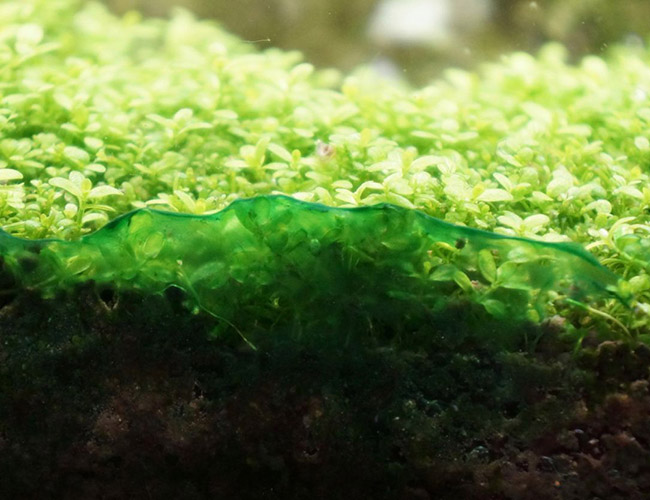
In saltwater aquariums, cyanobacteria often appear as a reddish-brown or dark maroon slime and are commonly called red slime algae. In freshwater aquariums, it typically presents as a blue-green, teal, or dark green film or sheet.
Although these forms look very different, they are closely related organisms. The variation in color and texture comes from differences in species and environmental conditions — not because they are fundamentally different substances.
This guide focuses specifically on freshwater cyanobacteria, the blue-green slime most commonly found coating substrate, plants, glass, and decorations in freshwater aquariums.
FishLab Fact: Certain types of cyanobacteria, such as spirulina, are cultivated safely and used in fish foods and supplements. The blue-green algae that appears in aquariums is different and should not be allowed to grow unchecked.
Other Names You May Hear
Blue-green algae is often referred to by several informal names, including:
- BGA
- Green slime algae
- Smear algae
- Pond scum
While “pond scum” and aquarium blue-green algae are both forms of cyanobacteria, they typically develop under different conditions. Pond blooms usually occur in stagnant outdoor water with heavy nutrient runoff, while aquarium outbreaks are driven by nutrient imbalance, flow issues, and localized tank conditions.
Although related, their behavior and treatment differ — which is why solutions that apply to ponds don’t always translate well to aquariums.
Why Blue-Green Algae Appears (5 Real Causes Explained)
Blue-green algae doesn’t appear at random.
While cyanobacteria are well studied, outbreaks in aquariums are usually the result of specific imbalances, not a single isolated problem. When several conditions line up, cyanobacteria can quickly gain the upper hand.
1. Nutrient Imbalance (Especially Low Nitrates)
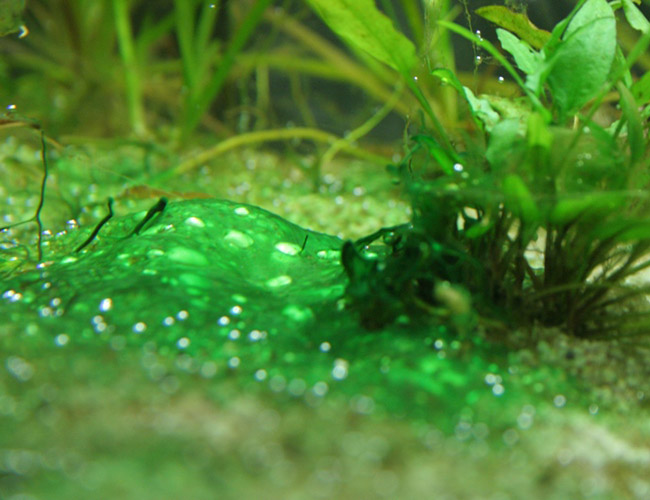
One of the most consistently observed conditions associated with blue-green algae outbreaks in freshwater aquariums is very low or zero nitrate levels, particularly in planted tanks.
Unlike true algae and higher plants, cyanobacteria are not dependent on nitrates in the same way. When nitrates are depleted, plants slow their growth, leaving less competition for space and nutrients. Cyanobacteria can then spread rapidly across surfaces with little resistance.
This is why blue-green algae often appears in tanks that otherwise seem “clean” or well-maintained.
In many cases, raising nitrates to a moderate, stable range (around 10–20 ppm) helps restore balance and makes it much harder for cyanobacteria to return once removed.
2. Available Phosphate Without Competition
Blue-green algae outbreaks are especially likely when phosphate is available, but plant growth is limited.
Phosphate is naturally introduced through fish food, waste, and decaying organic matter. When plants are not actively growing — due to low nitrates, poor lighting balance, or inadequate circulation — cyanobacteria can take advantage of this excess phosphate.
The issue is rarely “too much phosphate” on its own, but rather phosphate without healthy plant competition.
3. Poor Flow and Dead Zones
Cyanobacteria thrive in low-flow, stagnant areas of an aquarium.
Common problem areas include:
- Along the front glass where the substrate meets the tank
- Behind decorations and driftwood
- Dense plant thickets with limited circulation
These dead zones allow organic waste to accumulate and create ideal conditions for cyanobacteria to anchor and spread.
Improving water movement alone is sometimes enough to prevent repeat outbreaks.
4. Organic Buildup and Neglected Substrate
Uneaten food, fish waste, and decaying plant matter all contribute to localized nutrient spikes.
When organic debris settles into the substrate or hardscape, it creates micro-environments where cyanobacteria can establish themselves, even if overall water parameters look acceptable on a test kit.
This explains why blue-green algae often starts in small, specific patches before spreading outward.
5. Lighting: A Commonly Blamed but Overstated Factor
Lighting is frequently blamed for blue-green algae, but it is rarely the root cause by itself.
Cyanobacteria can grow under a wide range of lighting conditions. Excessive light may accelerate growth once an imbalance exists, but reducing lighting alone rarely eliminates an outbreak.
This is why blackouts and light reduction often produce inconsistent or temporary results.
The Key Takeaway
Blue-green algae is best viewed as a symptom of imbalance, not a standalone problem.
A combination of factors drives most outbreaks:
- Low nitrates
- Available phosphate
- Poor circulation
- Organic buildup
Addressing these conditions not only removes an existing bloom but also prevents it from returning.
How to Identify Blue-Green Algae in Your Aquarium
Blue-green algae is often misidentified in its early stages, especially in planted tanks, because it can blend in surprisingly well with healthy plant growth.
Catching it early makes removal far easier, so knowing what to look for is essential.
Early Warning Signs Most People Miss
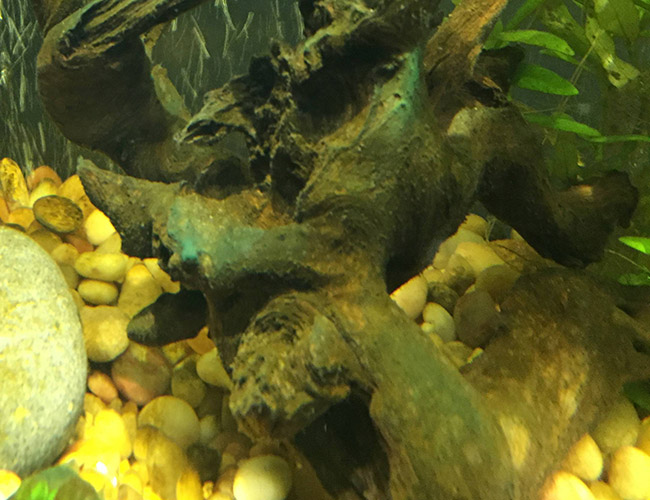
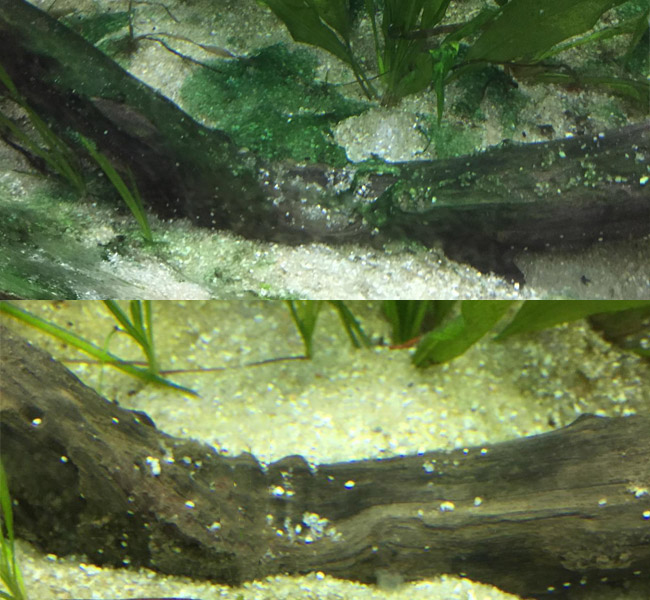
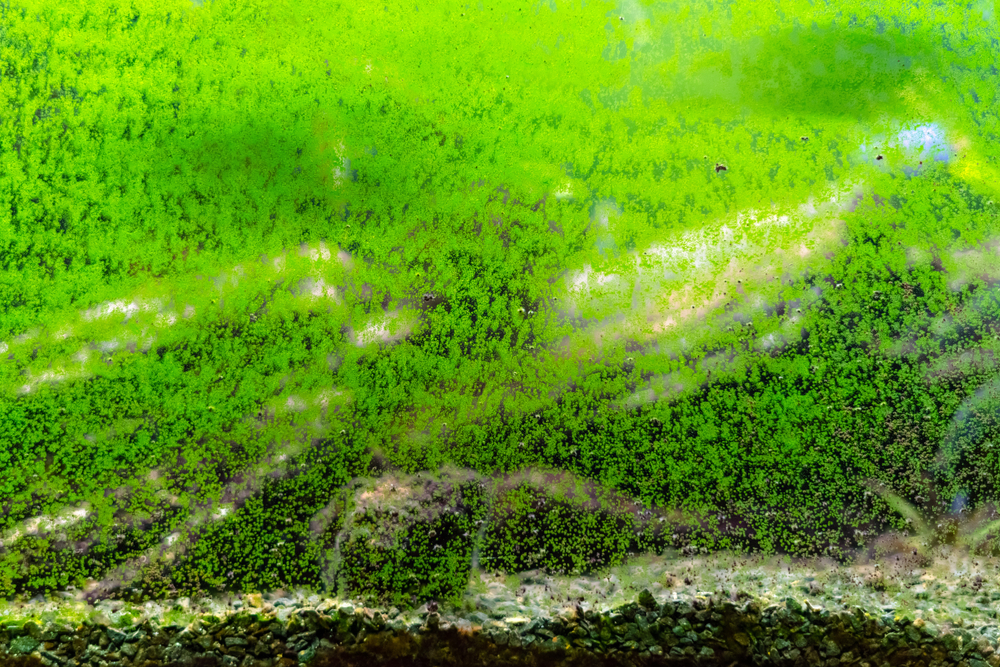
In the beginning, blue-green algae rarely appear as dramatic sheets of slime. Instead, it often starts as small, flat smudges that cling tightly to surfaces.
Common early locations include:
- Along the front glass where it meets the substrate
- On hardscape with strong light exposure
- On slow-growing plant leaves
- In low-flow areas or corners of the tank
At this stage, it may look harmless, almost like dust or a faint green stain, which is why many aquarists ignore it until it spreads.
Texture, Color, and Growth Patterns
As blue-green algae becomes established, its characteristics become much more obvious.
Typical traits include:
- Smooth, slimy texture (often described as greasy or slick)
- Sheet-like growth rather than strands or tufts
- Colors ranging from blue-green and teal to dark green
- Rapid horizontal spreading across surfaces
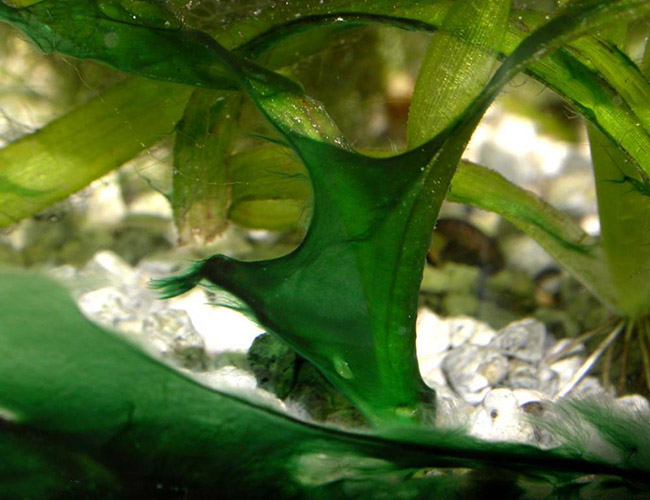
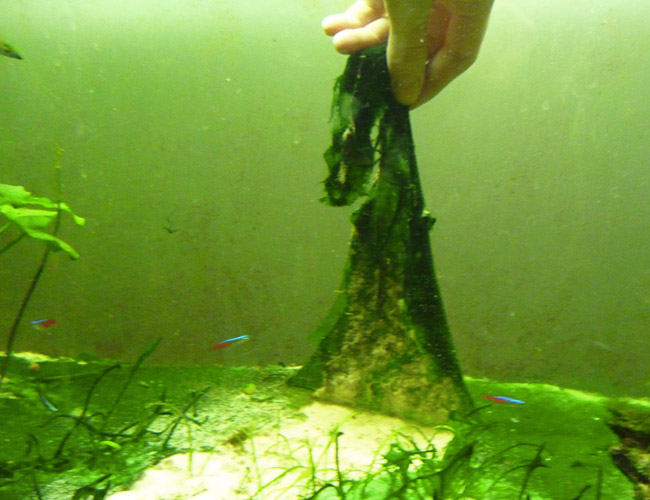
Unlike true algae, blue-green algae tends to peel off in large sections when disturbed. If you try to remove it by hand or siphon, it often lifts away in slimy mats rather than breaking apart into fine strands.
As it thickens, you may also notice small air bubbles trapped beneath the surface, a result of photosynthesis occurring within the sheet.
Odor: When Smell Is (and Isn’t) a Clue
One of the more unpleasant giveaways of blue-green algae is its smell, but this clue is not always present.
- Some outbreaks produce a strong, swampy, or rotting-plant odor, especially when disturbed. In these cases, the algae itself may be the source of a foul-smelling tank.
- However, not all cyanobacteria produce a noticeable odor. The absence of a smell does not rule it out, especially in early or localized outbreaks.
Smell can support identification, but it should never be your only diagnostic tool.
Blue-Green Algae vs Common Look-Alikes
Blue-green algae is most commonly confused with other types of algae. The differences become much clearer when you compare texture, growth pattern, and appearance side by side.
| Type | Appearance | Texture | Growth Pattern |
|---|---|---|---|
| Blue-Green Algae (Cyanobacteria) | Blue-green, teal, or dark green sheets | Slick, slimy, or greasy | Spreads outward as connected mats that peel away easily |
| Green Hair Algae | Bright to dark green strands | Coarse, stringy, or fibrous | Grows upward as long threads or clumps |
| Fuzz or Dust Algae | Fine green or brown coating | Soft or powdery | Appears as a light film on surfaces without spreading mats |
| Diatoms (Brown Algae) | Brown or tan dusty coating | Soft, dusty, or slightly gritty | Wipes off easily and does not form thick sheets |
A helpful rule of thumb: if it spreads quickly, peels off in sheets, and feels slimy, you are very likely dealing with blue-green algae rather than true algae.
The Bucket Test
If you are still unsure whether you are dealing with blue-green algae, there is a simple observation test that can help support an identification.
Fill a small bucket or container with about one inch of aquarium water. Place a few small pieces of the suspected growth at the bottom and leave it undisturbed for 24 hours.
If the material begins to expand outward or form a thin, connected film, this strongly suggests cyanobacteria rather than true algae. While this test is not definitive on its own, rapid spreading in still water is a common characteristic of blue-green algae.
Is Blue-Green Algae Dangerous?
Blue-green algae often raise concern because some cyanobacterial species produce toxins. While this reputation is not unfounded, the actual risk in a home aquarium depends on how severe the outbreak is and how long it goes untreated.
Let’s break down what that means for fish, plants, and you.
Will Blue-Green Algae Harm Your Fish?
Some species of cyanobacteria are capable of producing toxins, but in freshwater aquariums, blue-green algae rarely harm fish directly.
Most fish instinctively avoid eating it, which significantly reduces the risk of toxin ingestion. While there are no reliable aquarium fish or invertebrates that consistently consume blue-green algae as a food source, this avoidance actually works in your favor.
That said, blue-green algae can still harm fish indirectly if an outbreak is allowed to spread.
As it expands, cyanobacteria can:
- Reduce oxygen exchange at the substrate and surface
- Create stagnant, low-oxygen dead zones
- Contribute to declining water quality as large mats die off
In advanced infestations, these conditions can stress fish, suppress immune function, and increase susceptibility to disease, particularly in smaller tanks or heavily stocked aquariums.
For this reason, blue-green algae should always be addressed promptly, even if your fish appear unaffected at first.
Will Blue-Green Algae Harm Your Plants?
Yes, blue-green algae can be very damaging to aquarium plants.
Unlike most true algae, cyanobacteria form thick, slimy sheets that spread across leaves, stems, and the substrate. As these sheets expand, they block light from reaching plant surfaces.
Since aquatic plants rely on light for photosynthesis, prolonged coverage can cause:
- Slowed growth
- Leaf melt
- Eventual plant death
Plants that are already stressed due to nutrient imbalance or poor circulation are especially vulnerable. In severe cases, blue-green algae can wipe out entire sections of a planted tank if left untreated.
Is Blue-Green Algae Dangerous to Humans?
In most home aquariums, blue-green algae does not pose a serious risk to humans, but basic precautions are still recommended.
While toxin levels in aquariums are typically very low, direct contact should be minimized.
When dealing with blue-green algae:
- Avoid touching it unnecessarily
- Wash your hands after tank maintenance
- Never siphon by mouth
- Avoid inhaling dried residue
These simple precautions are more than sufficient for routine aquarium maintenance and help eliminate unnecessary risk.
How Fast Blue-Green Algae Spreads (And Why It’s So Aggressive)
One of the most frustrating aspects of blue-green algae is how quickly it can take over a tank.
Once established, cyanobacteria can visibly spread in as little as 24 hours, forming expanding sheets that creep across substrate, plants, and hardscape.
Growth Speed Explained
Blue-green algae spreads differently from many common aquarium algae. Instead of growing as isolated spots or long strands, it often expands outward as connected mats. In the right conditions, those mats can thicken and multiply rapidly, which is why small patches can become a full outbreak in just a few days.
Why Cyanobacteria Outcompete Plants
Blue-green algae have several advantages that allow them to outcompete plants and true algae:
- It can photosynthesize efficiently under a wide range of conditions
- It thrives in low-flow, low-competition environments
- It spreads as connected sheets, not isolated spots
When nutrients and circulation are out of balance, cyanobacteria can exploit those conditions faster than plants can respond.
Why Waiting Makes Removal Harder
The longer blue-green algae are left untreated:
- The thicker and more established the mats become
- The more organic waste becomes trapped beneath them
- The harder it is to remove without fragments breaking off and spreading
Early intervention is key. Small outbreaks are far easier to eliminate than mature infestations that have already covered large areas of the tank.
How to Get Rid of Blue-Green Algae (Proven Methods That Work)
Blue-green algae can be stubborn, but it is not unbeatable. The key is understanding that cyanobacteria behave differently from true algae, which is why many common algae control methods fail.
Why Algae Eaters and Blackouts Fail
Algae-eating fish, shrimp, and snails are often recommended for algae problems, but they are ineffective against blue-green algae. Cyanobacteria are generally avoided by clean-up crews and do not provide reliable control.
Blackouts and light reduction can slow growth temporarily, but they rarely eliminate blue-green algae completely. Cyanobacteria can survive low-light conditions and often return once normal lighting resumes.
These approaches may reduce symptoms, but they do not address the underlying conditions that allow cyanobacteria to thrive.
What Actually Kills Cyanobacteria Safely?
Effective treatment requires methods that directly disrupt cyanobacteria while preserving beneficial bacteria, fish, and plants. The following approaches are the most reliable when used correctly.
Best Low-Effort Option: UltraLife Blue-Green Slime Stain Remover Review
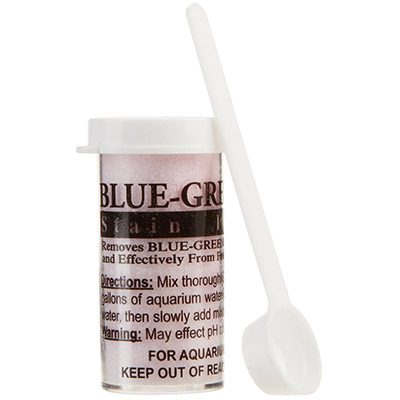
Products like UltraLife Blue-Green Slime Stain Remover are specifically formulated to target cyanobacteria without damaging the biological filter.
How It Works
When dosed according to instructions, this type of treatment interferes with cyanobacteria growth and causes existing mats to break down over time.
What to Expect During Treatment
Results are not immediate. In most cases, blue-green algae begins to darken, dry out, and detach over the course of several days. Visible improvement often occurs within one week.
During treatment, it is normal for cyanobacteria to appear worse before they improve, especially as dying material becomes more visible.
Safety Notes
Always follow dosing instructions carefully. Monitor ammonia, nitrite, and nitrate levels during treatment, and perform water changes if parameters become unstable.
Avoid combining this treatment with other chemical remedies unless specifically directed by the manufacturer.
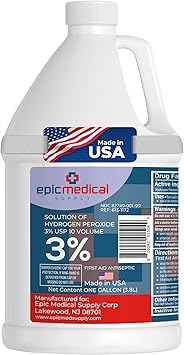
Hydrogen Peroxide Treatment (Advanced and High-Risk Method)
Hydrogen peroxide can kill cyanobacteria when used correctly, but it is not a beginner-friendly solution.
When It Makes Sense
Spot treatment with hydrogen peroxide may be useful in severe or recurring outbreaks when other methods have failed and when the aquarist has experience managing water chemistry.
Why Beginners Should Avoid It
Improper dosing can damage beneficial bacteria, harm fish, and melt sensitive plants. Because the margin for error is small, hydrogen peroxide should only be used by experienced aquarists following trusted dosing guidelines. If you are not careful, you can kill off all the good bacteria in your biological filter and harm your fish and plants.
Important: If hydrogen peroxide is used, it should only be the common 3% household concentration. Higher-strength solutions are unsafe for aquarium use and can cause serious harm. Use this guide for some dosing guidelines for hydrogen peroxide.
Manual Removal (Control, Not a Cure)
Manual removal can reduce the visible spread of blue-green algae, but it does not eliminate the underlying cause.
When It Helps
Removing large mats can improve tank appearance and reduce oxygen blockage while other treatments take effect.
How to Avoid Spreading It
Use a siphon or turkey baster to remove sheets gently. Avoid tearing or scraping aggressively, as broken fragments can settle elsewhere and regrow.
Manual removal should always be combined with another treatment method for lasting results.
How to Prevent Blue-Green Algae From Coming Back
Once blue-green algae is removed, prevention becomes the priority. Long-term success depends on restoring balance rather than eliminating nutrients entirely.
Ideal Nitrate Range for Planted Tanks
Maintaining stable nitrates helps plants outcompete cyanobacteria. In most planted freshwater aquariums, a nitrate range of approximately 10 to 20 ppm provides a healthy balance.
Zero or near-zero nitrate levels often create conditions where cyanobacteria can return.
Balancing Phosphate Instead of Eliminating It
Phosphate is not the enemy. Problems arise when phosphate is present, but plant growth is limited.
Rather than trying to remove phosphate completely, focus on supporting healthy plant growth through balanced nutrients, lighting, and circulation.
Improving Flow and Eliminating Dead Spots
Cyanobacteria favor stagnant areas. Improving circulation helps prevent the buildup of organic waste and removes the low-flow zones where blue-green algae often starts.
Adjust filter output, add circulation pumps if needed, and reposition hardscape to improve water movement.
Maintenance Habits That Prevent Recurrence
- Vacuum substrate regularly
- Remove decaying plant matter promptly
- Avoid overfeeding
- Perform routine water changes
By maintaining stable conditions and addressing imbalances early, blue-green algae becomes far less likely to return.
4 Common Mistakes That Make Blue-Green Algae Worse
When dealing with blue-green algae, well-intentioned actions can sometimes make the problem worse. Avoiding these common mistakes can save time and prevent repeat outbreaks.
1. Over-Cleaning Filters
Excessive filter cleaning can disrupt beneficial bacteria that help keep water chemistry stable. When biological filtration is weakened, cyanobacteria can take advantage of the resulting imbalance.
Rinse filter media gently in old tank water and avoid deep cleaning unless the flow is significantly reduced.
2. Starving Plants of Nutrients
Reducing nutrients to fight algae often backfires. When plants are starved of nitrates or other essential nutrients, their growth slows, leaving less competition for cyanobacteria.
Healthy, actively growing plants are one of the best defenses against blue-green algae.
3. Blindly Reducing Lighting
Lowering light intensity or duration without addressing nutrient and flow issues rarely solves the problem. Cyanobacteria can survive under low-light conditions and often return once normal lighting resumes.
Lighting adjustments should support plant health, not compensate for imbalances elsewhere in the tank.
A Word About Blackouts: Temporarily blocking light may slow blue-green algae growth, but it rarely eliminates cyanobacteria on its own. Blackouts do not correct the nutrient and circulation imbalances that cause outbreaks, which is why blue-green algae often returns once normal lighting resumes.
4. Relying on Algae Eaters
Algae-eating fish, shrimp, and snails do not provide reliable control of blue-green algae. Most avoid cyanobacteria entirely.
Depending on a clean-up crew alone delays effective treatment and allows the outbreak to spread.
Beating Blue-Green Algae for Good
Blue-green algae can be frustrating, but it is not a mysterious problem or a permanent condition. Successful control depends on understanding what cyanobacteria are, recognizing them early, correcting imbalances, and using targeted treatments when necessary.
Once removed, maintaining stable nutrients, good circulation, and consistent maintenance makes blue-green algae far less likely to return.
Explore More Common Aquarium Problems and Solutions
Blue-green algae is just one of many challenges aquarium keepers face. Many tank issues are connected, and improving one area often leads to better overall stability.
If you want to take your aquarium care further, these guides cover some of the most common mistakes, misconceptions, and improvements that can make a real difference:
- Things Fish Keepers Should Never Do
- Common Fish Owner Mistakes and How to Avoid Them
- The Worst Fish for Beginners (and Why)
- Easy Hacks for a Crystal Clear Fish Tank
- How to Create a Self-Sustaining Aquarium
- The Complete Guide to Fish Nutrition
- Feeding Tips to Boost Your Fish’s Health
By addressing these fundamentals, you will not only reduce the chances of blue-green algae returning but also create a healthier, more stable aquarium overall.
Have you dealt with blue-green algae in your aquarium? Share what worked for you in the comments below. Your experience could help other aquarists avoid the same frustration or solve the problem faster.



This helped me very much, thank you! Last night I decided to black out my tank because I saw somewhere else it said to do that I took out all my plants and put them in a quarantine tank but I guess I didn’t have to.
Okay, so I used this “blue exit” by easy life. I used it for its 5 days then waited another 5 days as required. I also blacked out the aquarium for 2 days. I’m happy to report I’m finally free of this horrible stuff. I have got some brown dirt around the ornaments and glass (might be brown algae or dead blue green algae) but the important thing is it’s gone. I hope it doesn’t come back
Hi Joey,
That’s awesome news! I’m so relieved to hear it. If you have eradicated it, and your water parameters are within the expected ranges, I wouldn’t expect it to come back. I have my fingers crossed!
Thanks Ian.
Our city water supply has become contaminated with Cyanotoxins. I have large hot water tanks I use for food prep , so how can I effectively decontaminate the hot water heater tanks after the city water warning has lifted?
hello, thanks for the article, I have used the remover but it comes back, i have used hydrogen peroxide and comes back, i am going to use now Kent Poly-Ox, but i am afraid with my Malaysian snails, the Nerites i have i can take out. what do you think?
Hi Agustin,
Is the blue-green algae completely dying off? or are there traces left behind? Because if it’s dead and coming back, it’s possible that there is another issue at play. Have you checked your water parameters to make sure everything is as expected?
Unfortunately, I have no experience with Kent Poly-Ox. I believe it contains manganic acid (H2MnO4), which should act similar to Potassium Permanganate (KMnO4) – so make sure you read up on how this will affect your tank.
That slime remover works like magic. One day my tank was a green mess, the next good as new. Thank you for letting me know.
Hi Gwen,
Happy to hear that the treatment worked for you!
What about the blackout method? Why isn’t that listed?
Hi Benjamin,
As I touched on in the article, while some people experience great success with blacking out their tank, others find that the process does absolutely nothing.
There could be numerous reasons for this:
1. The blackout is done in addition to other steps (such as improving water parameters) and the black out method is being falsely attributed with resolving blue-green algae.
2. There are multiple types of blue-green algae. While they may look similar, some might not be affected by the blackout method.
My personal experience is that the blackout method alone doesn’t work. Years ago, when I first dealt with a blue-green algae outbreak, I attempted the blackout method without any success.
I would love to hear from others who have had success blacking out their tank.
This is the best article I have run across on cyanobacteria. I won a battle against it in 2 of my tanks using manual removal and frequent water changes. Very nasty stuff, smells horrible, can’t be good for tank inhabitants.
Hi Sandra,
Thanks for the lovely feedback.
You did well to see get rid of it with just with manual removal – Impressive!
Would you like to share your secret as to how you did it? I only ask as every case of manual removal I have seen has resulted in a quick return of blue-green algae. Although admittedly these were tanks that were completely over run with the stuff, so it was almost impossible to remove every tiny piece.
Hi there, thanks for the terrific article. Did Sandra ever reply with her technique for thorough manual removal. I have a 2 gallon tank with an ongoing cyanobacteria problem that for now I’m managing but have yet to solve. I added a bunch more plants. Good to know about the nitrates I will test and add N if needed. They had been testing 0 so I will likely add..
Hi Joe,
Unfortunately, Sandra never replied. I was very interested myself. I have a suspicion that she only had a small amount of bluegreen algae and was able to keep on top of it before it spread too much.
If your nitrates are reading zero you likely have a nitrate reducing filter media, like zeolite, or perhaps your tank is really heavily planted. Otherwise, nitrates build up over time. It’s one of the reasons water changes are so important.
Did you try the blue slime remover?
Thank you for the article and advice. I’ve been battling BGA for several months, it wasn’t spreading as quickly as others have described but on doing your ‘bloom’ test it definitely is BGA. I’ve spent a small fortune on various treatments including one called ‘Blue Green Exit’ – none of which had any lasting effect. Finally took the plunge and ordered Blue Green Slime Remover from the States as it is not available in UK. Postage cost as much as container – but I don’t care – BGA has gone!! Nitrates are around 20 and always have been, so it wasn’t due to low nitrates. I think BGA came from tap water. I have now stocked up with new plants and also ‘Moss Balls’ (which apparently use up excess nitrates) and hoping BGA will stay away! Is it worth repeating dose every few weeks as prevention or only if I see the dreaded stuff return?
Hi Lesley,
I’m really happy to hear you won your battle with BGA! Yeah, that Blue Green Slime Remover is magic stuff.
I have never used Blue Green Slime Remover as a preventative measure, only on a noticeable outbreak. In my experience a single dose followed by keeping a close eye on water parameters has stopped it from returning.
However, if it’s present in your local water supply then you will re-introduce it into your aquarium each time you perform a water change. If this is the case, you may need to pre-treat your water or find an alternate source. Personally, I’d wait and see if it returns first to see if this step is necessary or not. Do other fish keepers in your local area also have BGA problems? They would also be using water from the same supply.
Hi
My story is very similar to Lesley and we are both in the UK. I too tried “Exit Blue” but it only partly worked. It was after reading this article that I sent to the US for the UltraLife product. Came on Saturday and dosed immediately as I had just done my weekly water change. Today, Monday and it seems to have gone leaving a black residue that shrimp, otos, and mollies are eating.
I think there are so many strains of the bacteria the causes and behavior are so varied. Nitrate is not my problem I am dosing it every day through EI fertilization.
The problem with looking this up on Internet forums is that from my observation I don’t think those people who answer posts have actually had this problem so they give answers like, “your tank is out of balance”, do more water changes etc. In the case of BGA, this is not going to work.
This has to be one of the best articles on the subject.
Remember this organism has had over 3.5 billion years to develop its resources.
Thanks
Robert.
Hi again, Robert.
I agree with your thoughts entirely: Even though it looks like we are all dealing with the same BGA, the strain and how it reacts to treatment may vary.
Anecdotally, I have come across what I believe to be two types of blue green algae during my time fish keeping.
One type smelled really bad when you lifted it out of the water. Like a rotting swamp smell. It almost made me gag.
The other had no scent. But it looked identical.
The variation in strains is very likely the reason some people experience success with blacking out their tank and others don’t. I have never had success with the blackout method, which is why I recommend UltraLife. However, as you suggest, it’s possible even this won’t work on certain strains.
Thanks for sharing your thoughts and experiences!
Try easylife blue. I’m in the UK too
Love this posting and all replies! I have been battling this for some time and just wondering if I should remove the plants that are covered such as my moss balls that are completely covered I also have duck weed and afraid that stuff is just going to make this a real long process. I’m kinda thinking I should start from scratch. Also what about the drift wood and I going to have to remove this as well.
Hi Ashley,
While it’s possible that it’s too late to save your moss balls, the green slime remover I mentioned in this guide will kill the blue green-algae coating all these surfaces. You shouldn’t need to remove them from your tank.
I know it can be disheartening, but you shouldn’t need to start from scratch. As for Duckweed, that’s a whole other problem – but it shouldn’t have any impact on removing blue green-algae.
This article helped me so much! I had absolutely no idea what I was up against. My nitrate level is too low, does anyone have a tip on how to raise it? Thanks!
We had a BGA outbreak and with much research was thrilled to find your information. We immediately got and used UltraLife Blue-Green Slime Stain Remove as directed, took two treatments and was gone!!! Beautiful. A couple months later it has returned, slow growing but frustrating. We’ve followed the directions carefully and have done three treatments for the second outbreak and it doesn’t seem to effect it much if at all. Water changes, manually removed what we could, water levels/parameters are good.
Realizing there can be different strains – wondering if you have any ideas for the next step?
Hi Amber,
Ugh, I feel for you. Recurring blue-green algae is something that has me stumped as I have never observed it first hand, after a successful eradication. Only ever read experiences in online forums. Every time I have personally observed successful removal of blue-green algae, It has never returned – Whether fighting it myself or helping members of my local fish club battle the stuff. So while I can’t really comment on the fact that it has returned and how to prevent it. However, I can suggest two alternate treatments that I have seen work. These might be worth trying since the Slime Remover is not working this second time? The first is spot treatment with H2O2, if it’s slow growing and isolated to one or a couple of places, this should get rid of it. If it has taken over your tank, you may have to treat in sections. The next one is erythromycin. However, depending on where in the world you are located, this can be difficult to come across. It’s also considerably more expensive than Hydrogen peroxide, so I would make that the starting point.
Wait… if blue green algae isn’t toxic to fish that means the koi at work weren’t getting sick from it… well dang! What else causes the lose of scales, dropsy, pop eye, rotting flesh, cloudy eye, and fin loss?
Hi Amanda,
I’d start by testing your water with a test kit. Those issues, as well as the blue-green algae appearance, sound like a water quality problem
Thank you for the article. Can anyone verify that I can use the ultralife bluegreen stain remover with snails and shrimp?
Then if it is, can someone explain about increasing O2 during treatment? Is this as simple as putting an airstone in?
Hi Jody,
I have seen this used on a tank with ghost shrimp without issues. Anecdotally, there are plenty of other reports of using blue-green stain remover in shrimp heavy tanks, such as Amano, or Cherries. If you have a particularly sensitive or unusual breed of shrimp, I would suggest further research,
As for increasing O2, it’s as simple as you say.
thanks so much.
they are just basic little cleaning shrimp, so I think ghost shrimp, although they are red. I may just move the shrimp and snail for safety, but this tank has GOT to get treated. I do have the airstones now, so hopefully everything will go well.
They are most likely Red cherry Shrimp, sometimes called RCS, they are one of the most common red colored shrimp around. It sounds like you have the situation under control, If you follow the directions I am sure everything will go smoothly. Good luck!
So i got BGA in my shrimp tank it’s heavily planted i would consider at least. I have pressurized Co2 and i dose Ada liquid fertilizer. Im not sure how to raise nitrates if that is actually the problem. I do have my lights on for 9 hrs a day could that be the problem?
Hi Tim,
9 hours of lighting is about average for a tank and I would be hesitant to suggest that this is the problem. The first thing I would look at is test the water for whatever it is you are dosing and see if there is a nutrient imbalance. Once that is sorted, I would then focus on removing the blue green algae with slime remover.
I got rid of BGA by doing a full black out of the aquarium for three days. Before I removed as much possible with an old tooth brush. After 2 weeks it hasn’t come back. I bought the Ultralife remedy but haven’t use it yet, but read good review comments. This is a very good article about BGA.
Hi Ronnie,
That’s awesome to hear that you had success with the black out method, where possible, I prefer to go the route where chemicals are not used. Unfortunately, the black out method doesn’t appear to work for everyone where Ultralife Remedy has a much higher success rate. I’ll keep in mind that you removed as much as possible before the black out, next time someone asks about it. Thanks for sharing your experience!
Hello fishlab! I have a 55 gallon aquarium..with a marine lab filter made for a 100 gal tank….with one 12 year old flying fox and a variety of young barbs. The tank had been very stable for years….with fish living 10 years on average. My 12 year old pleco died (snowball type) and I began to have an algae problem….which developed into a blue green algae problem. I did a deep cleaning….scrubbing plants and walls and tube of the slime. I got some nerile snails and they died one by one..then I got a young snowball pleco..and after two weeks he has died. I am heartbroken…and very confused…can BGA kill Plecos and snails? Other ideas?
Hi Claire,
From my experience, fish are generally smart enough not to eat the stuff. Have you tested your aquarium water to see if your parameters are off? I only as as we often blame what we see, rather than what we don’t.
Far be it to me to question your learned knowledge Ian but I’ve had a similar experience to Claire. I’ve been running my tank for 9 months with 3 Cory cats that actually bred to 9. I then had an outbreak of this blue green disgusting ‘algea’ a few months after I set this tank up. It spread everywhere all over my moss. I scrubbed the tank, substrate (it’s a planted aquarium) the ornaments etc. It still kept coming back. I keep the tank spotless, weekly water changes etc. Nitrates were close to 0 (which I know now may have frustratingly caused it) at the time I didn’t know it was this bacteria. I just assumed it was algae. I bought two pleco both died. Then some of my corys I put the deaths down to some not so healthy bogwood which I binned. I then spent a month treating the tank for various bacteria & virus meds just incase. I then got some tetra & an otto. Otto was dead in a week as well as some tetra.
But my point was it seems to be the algae eaters who suffer most from this. Perhaps inadvertently eating it? Water quality was perfect throughout the 9 months of tank setup btw
Hi Joe,
No no, you should question everything! It’s how this hobby progresses. As an individual, I have experienced a lot over the past 30+ years but it would be impossible for me to know everything – there are too many different fish tank setups and types of fish to have personal experience with each one!
On the fish dying, the only way it could have killed your fish to this degree is if it got so out of hand it caused the oxygen levels in your tank to drop. However, this is typically easily observable – fish show very obvious symptoms such as gulping at the top of the tank.
That you say your tetras died too leaves me to think it was an issue separate to the blue-green algae, as these are not algae eaters and wouldn’t have died from eating it.
These are my suspicions – it’s always very difficult to “diagnose” an aquarium over the internet.
Thanks Ian for the reply.
I’ve not allowed it to get that bad and there’s no gasping. There’s definitively some kind of toxin going on there though which must be from the blue-green algae. I’m very careful with what I feed them & I’ve always kept the tank clean but it was second hand. Maybe it was contaminated. It’s such a horrible thing and frustrating that you can’t tell since ammonia and nitrite levels remain at 0. Every week I’m peeling it off my ornaments. I’m hoping this easylife blue green exit stuff I’ve just started using today works.
It sounds like you are a great fishkeeper and doing everything possible to right the issue – including monitoring your water parameters. I’ll be very interested to see how the blue-green slime treatment goes, every person I have recommended the UltraLife brand to has had amazing results. I have my fingers crossed the solution is as simple as this for you!
Thanks Ian, that’ll be my next buy if this treatment doesn’t work
I have my fingers crossed that your current treatment works – I can’t imagine the adventure you have had to get to this point. Good luck!
I was looking it up because my dog loves to swim and heard that there was a lethal amount of blue green algae in the great lakes where 100% chance she was going to jump in so I looked it up to make sure it’s was ok for here to swim not to solve a fish tank problem this problem could not be solved with this advice you should send this to all the cities on the edge of the lake’s
Hi,
Is there anyway to upload photos to show you my progress (or lack of it) I mistakenly put in a phosphate remover in the filter the other week. What with the plants and lack of nitrates this seemed to excel the problem. It’s now removed and being treated with blue green algae remiver
Hi again Joey,
Unfortunately, I don’t have a way to share photos – I’m not very good with computers and was never able to set up that functionality on this website. Thats interesting to hear that the phosphate remover caused it to grow quicker. Thanks for sharing that interesting tidbit. I hope the green slime remover is the final nail in the coffin!
Thanks, I’m also covering the tank in darkness for three days to hopefully kill it once and for all.
I have an aquarium in direct sunlight. Bag grows like weeds. It took 6 months for it to completely kill my amazon sword plant, by compleatoy covering every leaf. I found an easy way to temporarily rid tank of 80% . Go to Dollar store and buy a package of multiple children paint brushes. Best size. Is quarter inch. Brush the leaves, decorations, and glass., wiping algae on to paper towel..You will have to do this at least 2 times a week.
So far my fish seem to happily coexist with this creeping crud÷.
Thank you for this article. My 150 gallon freshwater tank has suddenly fell victim to this nuisance. When I first noticed it, I took out all the rocks and logs and rinsed them. Thought I had defeated it. But, 3 weeks later, I see it creeping back. I have ordered the Ultralife remedy and it should be delivered with in the next few days. I have 2 questions:
1. I have 5 Clown Loaches in this tank. I know they are sensitive to medications. Is this an issue with the Ultralife?
2. 1 run 2 filters on this tank. It is time to clean one of them. Should I do this prior to or after the Ultralife addition and dying off of the blue green slime? Thanks!
Hi Carol,
I hope the Slime remover kills your blue green algae for good, it feels like a losing battle otherwise.
To answer your questions,
1)I have no experience with clown loaches but have I have personal experience using it with kuhli loaches and they had no issues at all.
2)I would leave both in, just in case they are contaminated too and cleaning them leaves behind small traces.
Thanks for your speedy response!
I added 2 additional airstones and another powerhead pointed at the surface and dosed the tank last night.
I normally do at least a 30% water change every Saturday morning. When should I perform my next water change? Besides the 5 year old clown loaches, I have Rainbowfish, corys, a couple SAE and a few otos.
Hi Carol,
If you have not added it yet, the ideal would be to do a water change before using bluegreen exit. Otherwise just follow the instructions and test your water parameters each day, keep a particular close eye on nitrate spikes, since as the algae dies, it will decompose. Otherwise, you perform a water change when the cycle is over (otherwise you are diluting the strength of the treatment)
Curious if upping the nitrate level alone would be enough to let plants get the upper hand? I have a planted tank and noticed that plant growth slowed down about a month ago and now blue green algae has shown up (it really reeks). Putting two and two together, I’m guessing the plants had drawn down almost all the nitrates, capping their growth and giving blue green algae an opportunity to thrive. Have started adding a nitrate fertilizer this week to try and tip things back in the plants favour. The only place the blue green is really problematic so far is on my mosses (fissidens fontanus) since I can’t manually remove it from there without ripping out the moss in the process. My preference would be to not add any chemicals and I’m just wondering if anyone has had success with manual removal combined with addressing the underlying nutrient imbalance.
Hi Sam,
Do you use an aquarium test kit to regularly check your water parameters? This will typically give advance notice of anything that could go wrong – most aquarium problems can be traced back to an imbalance of nutrients.
Once there, it’s unlikely that upping the nitrates alone will kill off the blue-green algae.
I don’t test the water. I know I should, but haven’t wanted to spend the money on multiple test kits and have to explain more fish equipment purchases to my wife 🙂 Have generally been following the cues the plant community sends off. Started adding liquid carbon when the plants stopped growing and that made a big difference and all was well until the blue-green showed up, which I understand suggests low nitrates, so I have started dosing with nitrogen and potassium as well (was already using a comprehensive for trace elements). The only fertilizer I’m not adding right now is phosphorous, beyond the small amounts present in the comprehensive solution. From reading online, my assumption is that low nitrates plus phosphorus gave the blue-green its opportunity to takeover (guessing it stowed away on some grasses I had purchased).
On your advice, I ended up hitting it with Ultra-Life and that stuff is truly amazing. Didn’t do any damage to my plants or fish (had a air pump running) and didn’t even phase my shrimp. After 2-3 days the blue-green just came off in sheets. A week on now and the tank looks great. Would definitely recommend Ultra Life versus the messing around with manual removal or darkness or anything else. A week on and the plants are growing again as they’re no longer competing for nutrients and light with the blue-green. Even the really beat-up moss is bouncing back. Thanks so much for your helpful article and advice.
Ha, explaining fish purchases to the wife… I know that feeling all too well as she does the budgeting in hour home. I can understand why it’s a conversation you don’t want to have.
I’m so happy to hear you found success with the Ultra-Life, it sounds like your tank is back on the mend for good! Thanks for sharing your feedback!
What should the water perimeters be to keep this BGA nightmare away?? Mine is 0 ammonia, 0 Nitrite and 0 nitrates. and how do we UP the nitrates ?? My 3 Tanks are always cleaned regularly. I’ve been fighting it for months…This stuff keeps coming back! I’ll give the Ultra life a try.
Hi Tyra,
If your nitrates are zero, it sounds like your tank may not be cycled. Nitrates are the end product of the nitrogen cycle and unless you are doing something in particular to get rid of them, they should always be increasing until your water change drops the levels back down.
Isn’t blue green algae poisonous to humans as well? IE if we get it on our skin or ingest it, can’t we get really sick?
Hi tim,
Just like with anything in your tank, I’d advise you don’t eat it. You’ll get sick for sure. Anecdotally, I’ve handled the stuff in my tank and thoroughly washed my hands with soap afterwards.
I see that you’ve asked for comments from people who’ve had success with the black-out method. I have, multiple times, and it’s the first thing I’d recommend.
Details: I’ve had cyanobacteria in tanks at home, in the classroom, and in my laboratory fish tanks. The tanks affected have ranged from 20 gallons to 110. I’ve never had black-out NOT do significant damage to cyanobacteria, and when black-out hasn’t been possible I’ve often found that just cutting back on light lets me rapidly gain the upper hand with manual removal. Sometimes the cyanobacteria re-establishes later, which may be a problem, but I suspect that this is because I didn’t black-out tanks for long enough. Recently I blacked out a tank while I was away for a weekend, since I wasn’t feeding the tank anyway, and went from a green bottom to nothing. I’ve seen cyanobacteria creeping back again, but just a towel on the tank for the weekend knocked the cyanobacteria back so far that it wasn’t visible immediately after treatment. I’ve also never had black-out kill plants, and almost all my tanks are planted. (I suspect that cyanobacteria dies because every cell lives or dies on its own food stores, whereas plants can store food as a whole organism, and can therefore store enough to make it through a few days of no light.)
The reason I’d recommend black-out as the first method of treatment is that it’s free (assuming you already own things like towels) and reversible. If it doesn’t work for someone they can then spend money on something else, but if it does work you didn’t spend money and you don’t have any treatment chemicals in the tank. I’m not amazingly worried about treatment chemicals, but these are chemicals designed to kill something. Also, given my success knocking cyanobacteria back with black-out, even an “unsuccessful” treatment might reduce the cyanobacterial problem to one that can be handled manually. I’ve used short black-outs in this way once or twice, knocking back huge mats to isolated spots that can be removed.
Hi Eric,
Thanks so much for sharing this. I especially like the theory on how the cells die, it makes a lot of sense.
I also completely agree with the logic of it not being a product first approach, where you can give it a go and if it doesn’t work, then you can try something else.
Thanks again for your insight. I’m going to give blackouts another go, although I also hope I’m never in the situation again where I need to.
can you say how many days or hours are `short blackouts“?
Hi. I have a small planted tank and this algae slime killed quite a few plants before I figured out what to do. Right now, I am removing and cleaning the plants or wiping it off manually. I currently have several Amano shrimp and they’re doing an awesome job of cleaning up the other types of algae and preventing some of the reinfection of the blue-green algae. Will the stain remover kill my shrimp? I know other treatments will, so that’s why I’m asking. The shrimp also eat EVERYTHING on the bottom (except the blue-green algae). Will they eat up this tablet, too?
Hi Darlene,
Anecdotally tank owners with red cherries and amano shrimp have had huge success using this BGA killer. Also, Ultralife Blue Green Slime Remover is a powder. Like with any medication, you should keep an eye on your water parameters by testing and react accordingly.
Ian,
I came across this article and discussion while researching following a manual removal in 2 of my tanks. Based on this article I was able to identify the offensive attacking slime and quickly ordered the Ultralife product off Amazon. Frankly I couldn’t get it here fast enough…even though it only took 2 days to arrive.
I started the process about 15 minutes after delivery Sunday night, having already pre-staged an additional airstone in each tank.
After about 24 hours one tank looks unchanged, but the BGA in the second tank is noticeably duller than it was yesterday! No noticable change in water parameters yet. I’ll be cheering on the Ultrlife for the next few days, and hoping it kicks the BGA in the keester!
I know it’s early in the process, but wanted to reach out and thank you for the highly informative article and discussion, as well as the recommendations for resolving it! Fingers crossed!
Hi Klaus,
You managed to get it in both your tanks? That is a nightmare! I know it’s too late now, but buying individual tools for each tank will help spreading algae like this. For example, a net that is only used in that specific tank.
I’m cheering on your BGA battle from here too! Ultralife has always worked for me and members of the local fish club, I am sure it will work for you too! Please update me with how it goes!
Ian,
After this I will definitely not be using the same equipment for both tanks. I’m not sure that’s what caused the outbreak, but I’m not taking any chances going forward.
Added the 2nd dose last night as instructions indicated if it was required after 48 hours. Because extermination is a 4 or 5 day process, I wasn’t sure if it was needed or not. Since all of the fish (severums, angels, corrys, plecos, kuhli, synadontis) and plants were faring well and there were no negative signs, I decided to go for it because….(Sailor language redacted) that stuff.
72 hours in and all of the desirable life forms remain well. The main places the BGA set up camp have changed to a darker, dull green/brown instead of the bright green they were. The more minor places the BGA was trying to get a foothold have all but vanished!. There still seems to be some green in the substrate, but hope that will be vaporized also.
I remain optimistic that we will declare victory in this battle, and in the long run the war will be ours also with the new weaponry you have provided.
Hi Klaus,
It’s crazy how quickly things can spread from one tank to the next if you are not careful. Years ago I spread hydra throughout every one of my tanks by taking the plants out of one and splitting them across the others. Lesson learned. Now I even go so far as to thoroughly clean my gravel vacuum.
I can’t find my notes from the last time I battled bga but I’m pretty sure I used a second dose too. Although I must admit, my old memory isn’t what it used to be so take this with a grain of salt.
The color change is a sure sign that it is dying. It all sounds positive so far and I hope that the second dose knocks it on the head.
P.s I had to laugh at your creative way of swearing, I’m going to steal that line!
End of day 5 and the BGA has all but vanished!
There is a bit of residue in one or two of the heavy spots, but it’s no longer green….clearly dead. Even deeper in the substrate along the glass, it has faded into oblivion!
No negative signs from the plants or animals.
No ammonia spike or significant changes in water parameters or clarity.
A good gravel vacuum and water change tomorrow and I think I’m done for this battle.
My gratitude to you and I am very thankful that I came across this article.
PS- I tried to add a bit of humor to this foulf smelling, slimy situation….and keep it PG. Although I reverted back to my Sailor vocabulary, it was only while I was doing the manual removal, and I kept it out of the public eye….feeling accomplished,
Congratulations Klaus,
I’ll best that is a relief! Happy to hear that your experience with this product is another success story!
I”ve put in about 5 doses into my tank. Still have BGA. Product doesn’t work.
And before you claim that I’m doing something wrong I’m a PhD biologist and an aquarist for about 50 years.
Wish I could say the product works because BGA is a real problem in my tank – it doesn’t.
Hi Francis,
I’m sorry to hear you didn’t find the same success that the majority of others experience. Where are you located? As I touched on in my article, there are different types of blue-green algae and it is possible that some don’t react to Blue-Green Slime Stain remover, For instance blue-green algae sometimes has a distinct swamp-like smell, but I have come across cases where it doesn’t, and looks very slightly different. This is a big curiosity for me but unfortunately, I can only gather anecdotal data on the subject.
Let’s look at this product, Blue-Green Slime Stain remover. There are no active ingredients listed on the label. So it’s not a chemical/antibiotic designed to kill BGA/cyanobacteria like, for example, Erythromycin. After using the product it appears to me to be a beneficial bacteria of some sort of which there are numerous products on the market designed to cycle ammonia produced by fish to nitrite and nitrate. Nitrate is food for plants, algae and BGA. The key to knocking back BGA would be a bacteria capable of reversing this cycle and breaking down nitrate into nitrogen gas. Those bacteria do exist but they are anaerobic and the places where they could potentially get established in a typical aquarium are limited. In marine aquaria they can live deep in the recesses of “live rock” or in deep sand beds. In freshwater aquaria about the only option for an anaerobic area is a sufficiently deep sand bed, which most aquaria do not have.
So let’s suppose that Blue-Green Slime Stain remover is a denitrifying, anaerobic bacteria blend that can break down nitrates, potentially lowering the nitrate level in a tank and starving BGA of the food they need to survive. That could kill BGA. But the product would have to significantly reduce nitrates. Is it capable of doing that? I doubt it – not without lots of places where denitrifying, anaerobic bacteria could get established in a tank.
Most aquarists would be better off doing sufficient water changes to bring down the nitrate level in the tank or adding plants that feed on nitrates and compete with BGA. The problem with adding rooted plants to the aquarium gravel is that BGA uses the plant surface as one more place to grow. I’m going to try floating plants in my tank like Salvinia.
And let me clarify something. In this article you claim that BGA thrives in low nitrate environments and you can get rid of BGA by increasing nitrate levels in your tank.
This is what you stated above: “However, there is a cause that many experts agree on…
Low nitrates.[5]”
Your link takes one to … another web blog – not a scientific source. And the supposed expert for your claim provides no scientific evidence that the claim is correct. Just a lot of handwaving – incorrect handwaving I might add.
Let me try to explain: It is true that BGA can exist when nitrate levels in water are zero (so your first claim is correct). How? Well, unlike true algae and plants, they are capable of fixing nitrogen from the atmosphere dissolved in aquarium water into forms that they need to grow, namely ammonia and nitrate. Algae cannot grow when nitrates are zero, plants cannot grow where nitrates are zero. BGA can.
However, the converse is not true – the second part of your claim – that elevated nitrate levels will eliminate BGA. Instead BGA are quite happy when they are provided nitrates to grow on – they don’t need to fix atmospheric nitrogen when they can obtain nitrates from the water. And when nitrates are quite high you can get BGA blooms – and it’s these blooms that most aquarists are concerned about. Minor BGA growths wouldn’t bother most aquarists.
So to combat BGA blooms aquarists need to bring down nitrate levels. It is true that even if the aquarist brings down nitrate levels to essentially zero BGA can still survive. However at lower nitrate levels massive blooms are less likely.
Hi Francis,
Thanks for sharing your thoughts, it really is appreciated.
Surely something else must be happening with blue-green slime remover though. If it was just a lowering nitrates and nitrates, we would see 100% water changes be comparitively effective. However as you stated and based on anecdotal evidence, they are not. And unfortunately, anecdotal evidence is all we really have at the moment when it comes to battling BGA in an aquarium setting.
I completely get where you are coming from and, logically, I agree with your thoughts. That post I shared on the nitrate phenomeon is on the barr report, where many planted tank owners share their experience. This is the only written location I could find it but anecdotally, it has been repeated in the local fish keeping groups I have been to that low nitrates are a potential cause. Until a concrete confirmation made, this advice has helped some fishkeepers get rid of their BGA, (whether they indirectly did something else in addition is up for debate) so I’ll leave it in the guide for now.
I also agree that minor BGA growths wouldn’t bother many aquarists. Unfortunately, a large portion of aquarium owners are beginners or have not been in the hobby for years. They unrealistically expect their tank to be perfectly immaculate.
Thanks again for weighing in!
Really love this discussion. I think that a probiotic treatment is a legitimate method to treat CBA theoretically. It’s just probably ineffective. The low nitrate hypothesis makes logical sense. I appreciate the poster clearing that up for me. I.e nil nitrates favors CBA over plants due to it’s ability to fix nitrogen.
If it has that terrible smell, it is cyanobacteria. It has always worked in my case.
Thanks
I had nothing then suddenly I had this together with black beard algae. It came suddenly around two months ago. The first algae I noticed was a good deal of fine green hair algae. Then came the black beard simultaneously with the BGA. The hair algae stuck so hard had to cut the affected leaves off. The black beard I scrape off the glass with a plastic spoon,and the BGA I try to remove manually but I’m loosing the battle. I wonder if this stuff comes in the treated tap water? I was adding a plant-gro supplement for a few weeks but have stopped.
Don’t know what to do other than the blackout and this product. Will try the blackout first.
I change my water 20-25% every week regularly. Is this too much?
I have a cold water 20 gallon with only 7 small Daimos & Golden algae eater (who eats nothing looks like) but have the black beard starting in the heated tank upstairs with Tetras and Clown Loaches. Its depressing. At least the fish are doing ok, even though the plants struggle and the tank looks a bit ugly.
Hi Sooz,
I’m a big fan of the weekly water change and do not believe it is too much. It’s unlikely a water change alone would lead to the outbreak you are experiencing.
If I had to guess, I would say the problem is coming from the plant-gro supplement. Adding nutrients in an incorrect amount to tanks is a real balancing act that can quickly lead to algae.
Good luck on the blackout, I’ve never really had success with it, but I hope it works for you. I always prefer chemical free options where possible!
I had been at my wit’s end dealing with what I thought was traditional algae. granted, I had let my 70 gallon modestly planted aquarium go for the better part of a year, doing just the minimum upkeep but my fish were happy (my angels were spawning regularly), so I just procrastinated. By the time I got serious, my beautiful Amazon swords were covered with it and had started to die back, and it was growing like a carpet on my substrate (fluorite). I tried removing it by manual disruption and siphon, followed by 15-20% water change – and it just kept growing back, almost overnight. Tried the ultralife product prepared to be disappointed (as I have with other algae control products) and after two treatments (following directions, 48 hours apart, and adding two airstones for extra aeration as recommended) the ugly stuff is GONE. Okay, maybe a few traces, but that’s about it. I don’t usually write reviews of products but this one is worth it – no harm to my fish (like one anti-algae product that I tried and won’t name) and my Amazon swords are starting to show signs of new growth now that they are not coated with green slime. I’m a believer.
Thank you so much for sharing your experience! Blue-green algae can indeed be very stubborn, and it’s great to hear that the Ultralife product worked well for you without harming your Amazon Swords or plants. Your approach of combining manual removal, water changes, and treatment sounds very effective. It’s more encouraging to hear about your Amazon swords rebounding.